

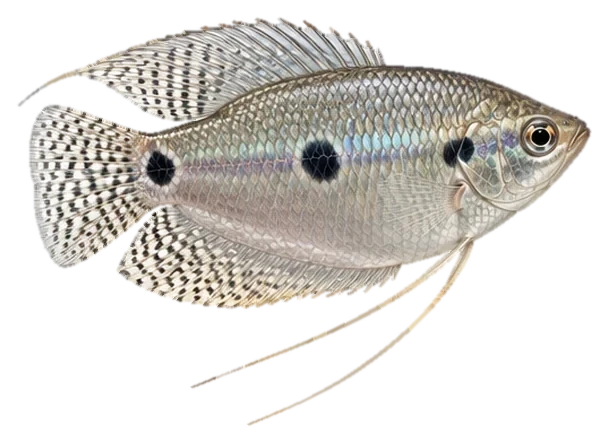
Breeding the three-spot gourami
Easy bubblenester: the male builds a bubble nest at the surface, gathers the eggs into it and guards them until the fry swim free. Remove the female after spawning or she may be harmed.
Step by step
Keep a group of young fish and pair off a male and female. They are easy and spawn readily.
A 20-30 gallon (75-110 L) tank, 26-28 C, floating plants and a lid. Water level of 15-20 cm is fine.
Warm water, floating plants and good food. The male builds a large bubble nest.
About 500-1,200 eggs per spawning; eggs hatch in around 20-30 hours.
Feed infusoria, then baby brine shrimp and crushed flake. Remove the female after spawning and the male when fry swim free. Sort fish for size often.
- Leaving the female in with the nest-guarding male
- Too much flow at the surface
- Overfeeding, which fouls the water
Male or female
Males are larger and develop a long, pointed dorsal fin; females have a shorter, rounded dorsal fin.
Can I breed it in my tank?
- Good for a first breeding project.
Day-by-day plan
Typical for bubble-nest builders
- 10 days beforeCondition and introduce
Feed well, then let the female see the male through glass before putting them together.
- Day 0Spawning under the nest
The male wraps the female and places eggs in the nest. Remove the female after spawning.
- Day 2Eggs hatch
Eggs hatch in 24–48 hours. The male catches falling fry and returns them to the nest.
- Day 4Free swimming
Remove the male. Feed infusoria and keep the air above the water warm and humid.
- Day 10Baby brine shrimp
Move on to baby brine shrimp and microworms. Change small amounts of water daily.
- Day 56Separate males
Males start fighting at about 8 weeks and need their own jars.
A general guide for this breeding type. Days change with temperature and species.
Simulator: guided
Feed well, then let the female see the male through glass before putting them together.
Simulator: try it yourself
Set up a virtual breeding tank and see what would likely happen.
- Without live or frozen food the parents aren't in breeding condition.
An educational estimate from the breeding rules, not a promise.