

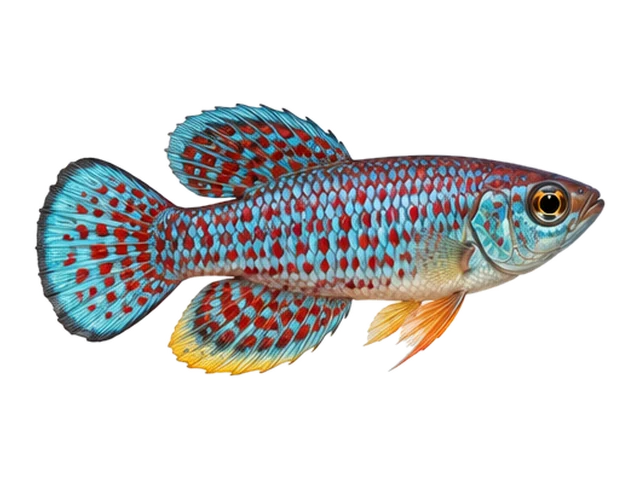
Breeding the turquoise killifish
Annual killifish: in the wild adults die when the pool dries and the eggs survive in the dry mud in diapause (a resting stage) until the next rains. In aquaria they spawn into peat or sand, and the eggs are stored in damp peat until they are ready to hatch.
Step by step
One male with 2-3 females.
Bare 20 L tank with a bowl of sterilised peat for spawning; soft water.
Warm water and live food; spawn in peat.
Wild females lay 20-120 eggs a day. Collect the peat every week or two, dry it to damp (like pipe tobacco) and store it sealed at 20-24 °C. Development time varies a lot: eggs can be eyed-up in 2-3 weeks at 27 °C or more, but often take months (FishBase: 5-7 months). Wet the eggs when the eyes are visible.
Baby brine shrimp from day one; fast growth.
- Not dry-storing peat long enough
- Wrong peat
- Keeping in hard water
Male or female
Males are brightly coloured with either a red or a yellow-and-black tail (two colour morphs); females are dull brownish.
Can I breed it in my tank?
- Takes some experience.
Day-by-day plan
Typical for killifish (egg buriers)
- Day 0Spawning in peat
Pairs lay eggs in peat or coco fibre over several days.
- Day 1Dry the peat
Squeeze the peat damp-dry and store it in a bag at room temperature.
- Day 60Wet the peat
After 1–4 months (depends on the species), add cool soft water. Fry hatch within hours.
- Day 61First food
Feed infusoria, then baby brine shrimp from day 3.
A general guide for this breeding type. Days change with temperature and species.
Simulator: guided
Pairs lay eggs in peat or coco fibre over several days.
Simulator: try it yourself
Set up a virtual breeding tank and see what would likely happen.
- Without live or frozen food the parents aren't in breeding condition.
An educational estimate from the breeding rules, not a promise.