

Variations
14 kinds · tap one for a closer look
Betta
A small fish with big, flowing fins and lots of personality. Males must live without other male bettas.
- Betta eats animals up to about 2.5 cm. Neon tetra only grows to 2.5 cm.
- Only a narrow temperature range suits both: 24–25 °C.
- Black skirt tetra nips fins, and Betta has long fins.
- Serpae tetra nips fins, and Betta has long fins.
- Betta may attack colorful long-finned fish like congo tetra.
- Only a narrow temperature range suits both: 24–25 °C.
383 species in our list are a good match.
Care and water
Behavior
Males fight other males to the death: one male per tank. May attack colourful long-finned fish and eat small shrimp.
Food
Carnivore: betta pellets, frozen bloodworms and brine shrimp.
Tap a food to see what it is.
Male or female
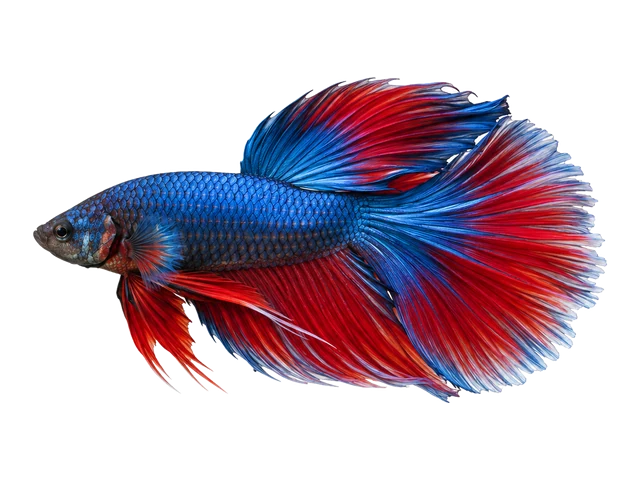
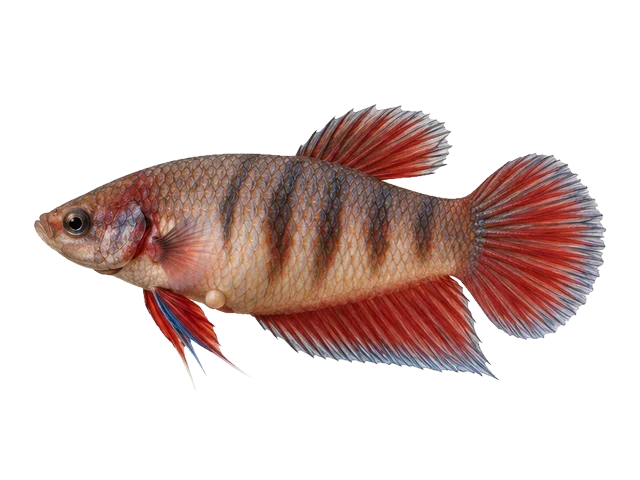
Males have much longer fins and stronger colors. Females have short fins and a small white ovipositor (egg tube) behind the belly fins.
Health
Common problems. Tap one to see the signs. This is a guide, not a diagnosis.
Breeding
Bubble-nester · Moderate
Bubble-nest builder. The male builds the nest at the surface and alone guards the eggs; they hatch in 24-48 hours, and he loses interest once the fry swim freely. Seriously Fish says the adults can normally be left in place.
Buy a healthy male and female from a good source. Condition both with live or frozen foods and let them see each other through glass first.
A 10 gallon (40 L) tank, 28 C, low water level, floating plants or a foam cup for the nest, and lots of hiding places for the female. Use a lid.
Warm water, rich food and a female showing pale vertical stripes. The male builds a bubble nest.
100-400 eggs. They hatch in about 24-48 hours; fry swim free in 3-4 days.
Feed infusoria, then microworms and baby brine shrimp. Remove the female after spawning, and the male when fry swim free. Males must be split into single jars at 8-10 weeks.
- Leaving the female in, so the male hurts her
- Too much water current that breaks the nest
- Not having enough jars for the fighting males
Where it lives in the wild
Plants that suit it
The story of the betta
Bettas come from the shallow rice paddies, ponds and slow streams of central Thailand's Chao Phraya basin. People there bred them for fighting for centuries; genetic work suggests they were domesticated at least 1,000 years ago. Long-finned show forms such as the veiltail appeared in the early 1900s and were developed further after the 1950s.
C. Tate Regan described Betta splendens in 1910. In Siam (Thailand), short-finned fighting fish had already been bred for contests long before that. Breeders have since created countless long-finned forms and colours, far removed from the plainer wild fish.
First described by C. Tate Regan in 1910.
- Bettas breathe air using a labyrinth organ.
- Males build bubble nests and guard the eggs.
- Wild bettas are much plainer than modern show varieties.
Sources
15 facts checked with sources
- Scientific nameSeriously Fish: Betta splendens
- FamilyFishBase: Betta splendens summary · Seriously Fish: Betta splendens
- Size
FishBase gives 6.5 cm TL (total length), matching the site. Seriously Fish gives 70 mm SL (standard length), slightly larger; the sources differ but FishBase is preferred for size.
FishBase: Betta splendens summary · Seriously Fish: Betta splendens - Temperature
Site range sits inside both sources' ranges.
Seriously Fish: Betta splendens · FishBase: Betta splendens summary - pH
Seriously Fish says ornamental (shop) strains tolerate pH 6.0-8.0; site range falls inside it.
Seriously Fish: Betta splendens · FishBase: Betta splendens summary - Hardness
Inside the Seriously Fish range (preferred for husbandry). FishBase gives 5-19.
Seriously Fish: Betta splendens · FishBase: Betta splendens summary - Smallest tankcorrected
45 x 30 cm base x ~30 cm height = 40.5 L; Seriously Fish lists ~41 L (11 US gal) for a single male or pair. 20 L is half the sourced minimum.
Seriously Fish: Betta splendens - Group size
Seriously Fish also: only a single individual can be kept per tank in most cases.
Seriously Fish: Betta splendens - Lifespan
Only source found is FishBase's max reported age of 2 years (likely from wild data), which conflicts with both the site (2-4) and legacy (3-5). No reliable source for captive lifespan was found, so left unknown rather than guessed.
FishBase: Betta splendens summary - TemperamentSeriously Fish: Betta splendens
- Swimming level
No source states it is a top-dweller; FishBase calls it benthopelagic. Its air-breathing (labyrinth) habit is sourced but does not by itself make it a surface fish.
FishBase: Betta splendens summary - Where it livescorrected
Core claim (Chao Phraya, Thailand) is right; Seriously Fish lists feral populations far beyond 'nearby countries' (incl. Brazil, Colombia, Dominican Republic). Wikipedia cites Vidthayanon 2013 (IUCN) for the Mae Khlong-Chao Phraya range. FishBase's 'Mekong basin' disagrees with Seriously Fish/IUCN; noted, not adopted.
Seriously Fish: Betta splendens · Wikipedia: Siamese fighting fish · FishBase: Betta splendens summary - Male or female
Fins/colour from Seriously Fish. The 'egg spot' is the ovipositor; Wikipedia cites Lichak et al. 2022 for it. 'Females are smaller' was not found in a source; consider dropping it. Seriously Fish notes spawning females show dark bars on the flanks (legacy 'vertical bars').
Seriously Fish: Betta splendens · Wikipedia: Siamese fighting fish - Breedingcorrected
Seriously Fish: the male takes sole charge of the nest and the adults can normally be left in place, so the site's 'remove the female' instruction is not supported by this source. Hatch time 24-48 h matches legacy. Legacy egg count 100-400 is within the 12-492 per spawning that Wikipedia cites to Lichak et al. 2022. Legacy 'fry swim free in 3-4 days' not found in a source.
Seriously Fish: Betta splendens · Wikipedia: Siamese fighting fish - Story
All site claims supported. Value adds the sourced 1,000-year domestication detail. The 'last hundred years' claim rests on Wikipedia citing Brammah, The Betta Bible (1927 veiltail article; 1950s American long-fin veiltail).
Seriously Fish: Betta splendens · Kwon et al., Genomic consequences of domestication of the Siamese fighting fish (bioRxiv 2021; later Science Advances 2022) · Wikipedia: Siamese fighting fish