

Variations
1 kinds · tap one for a closer look
Black ruby barb
Peaceful.
- Giant gourami eats animals up to about 10 cm. Black ruby barb only grows to 6 cm.
- Oscar eats animals up to about 12 cm. Black ruby barb only grows to 6 cm.
- Convict cichlid is aggressive and will bully peaceful black ruby barb.
- Only a narrow pH range suits both: exactly 7.5.
- Only a narrow temperature range suits both: 26–27 °C.
437 species in our list are a good match.
Care and water
Behavior
Peaceful.
Food
Flakes, pellets.
Tap a food to see what it is.
Male or female
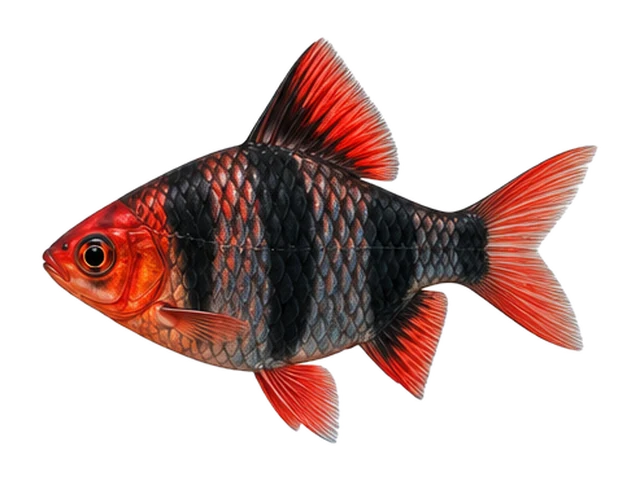
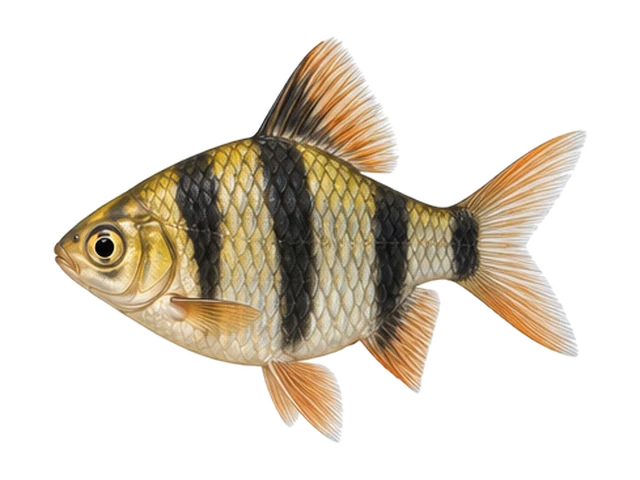
Males are smaller, slimmer and more colourful; in spawning colour the male's head and front body turn reddish-purple and the body darkens. Females are larger, paler, and keep the dark bands.
Health
Common problems. Tap one to see the signs. This is a guide, not a diagnosis.
Breeding
Egg-scatterer · Easy
Egg-scattering free spawner with no parental care; spawn in a separate dim tank over mesh, marbles or fine-leaved plants and remove the adults once eggs are seen.
Buy a group of 6 or more; males turn deep red when ready.
40 L tank with fine plants or mops. Slightly soft water.
Warm water, live foods and plenty of cover.
More than 100 eggs per spawning; eggs hatch in 24-48 hours and fry swim free about a day later.
Feed infusoria or liquid food for days 1-3, then baby brine shrimp and microworms. Grow out with frequent water changes. Sort by size to cut losses.
- Leaving parents with eggs
- Too bright
- Too small a group
Where it lives in the wild
The story of the black ruby barb
Described by Albert Günther in 1868 (as Barbus nigrofasciatus) and endemic to Sri Lanka. Breeding males turn reddish-purple on the head and front body. It is listed as Vulnerable by the IUCN and wild fish may not be exported from Sri Lanka.
Albert Günther described the black ruby barb in 1868 from Sri Lanka. In breeding colour, males turn almost black with a glowing ruby-red head, which gave the fish its name. It has been kept by aquarists for many decades and is now widely bred in captivity.
First described by Albert Günther in 1868.
- Breeding males turn almost black with a bright red-purple head.
- It is found naturally only in Sri Lanka.
- It is a peaceful barb suited to planted tanks.
Sources
16 facts checked with sources
- Scientific name
Moved from Puntius to Pethia by Pethiyagoda, Meegaskumbura & Maduwage 2012. Older names Barbus nigrofasciatus / Puntius nigrofasciatus are synonyms, still seen in shops.
Seriously Fish: Pethia nigrofasciata · FishBase: Pethia nigrofasciata summary - Familycorrected
Legacy had no family; new value.
FishBase: Pethia nigrofasciata summary - Size
FishBase gives TL: 6.0 cm males, 6.7 cm females. Seriously Fish 5.5 cm SL. Legacy 6 cm fits.
FishBase: Pethia nigrofasciata summary · Seriously Fish: Pethia nigrofasciata - Temperaturecorrected
FishBase matches legacy (22-26); Seriously Fish (preferred for husbandry) gives the wider 20-27. Small change; 22-26 is a safe middle.
Seriously Fish: Pethia nigrofasciata · FishBase: Pethia nigrofasciata summary - pHcorrected
Seriously Fish 5.5-7.5; FishBase 6.0-6.5. Legacy 6-7.5 sits within Seriously Fish's range; only the lower end widens. Wild fish prefer slightly acidic water.
Seriously Fish: Pethia nigrofasciata · FishBase: Pethia nigrofasciata summary - Hardnesscorrected
Legacy had no hardness. Seriously Fish 2-15 (wild fish best at the low end); FishBase 5-12.
Seriously Fish: Pethia nigrofasciata · FishBase: Pethia nigrofasciata summary - Smallest tankcorrected
Seriously Fish footprint 80 x 30 cm; at 30 cm height = 72,000 cm³ = 72 L (Seriously Fish states ~72 L). Legacy 80 L is slightly more generous; fine as a recommendation.
Seriously Fish: Pethia nigrofasciata - Group size
Seriously Fish: 6-10 minimum; more is better.
Seriously Fish: Pethia nigrofasciata - TemperamentSeriously Fish: Pethia nigrofasciata
- Swimming level
Benthopelagic = mid-water to near the bottom. Seriously Fish does not state a zone; treat as mid-to-lower water.
FishBase: Pethia nigrofasciata summary - Care level
Seriously Fish care rating: Easy.
Seriously Fish: Pethia nigrofasciata - Where it livescorrected
Legacy had no range field (about says 'From Sri Lanka'). Export of wild fish from Sri Lanka is prohibited, so trade fish are farm-bred (Seriously Fish).
FishBase: Pethia nigrofasciata summary · Seriously Fish: Pethia nigrofasciata - Male or female
Legacy is right on colour; added that males are smaller. The colour is reddish-purple rather than pure ruby red.
Seriously Fish: Pethia nigrofasciata · FishBase: Pethia nigrofasciata summary - Breeding
Legacy setup (40 L tank, fine plants or mops, slightly soft water) agrees in substance with Seriously Fish.
Seriously Fish: Pethia nigrofasciata · Wikipedia: Black ruby barb - Eggs and young
Hatch time confirmed by Seriously Fish. Egg count: Wikipedia says 'more than 100' (uncited); the legacy upper bound of 300 is not sourced.
Seriously Fish: Pethia nigrofasciata · Wikipedia: Black ruby barb - Story
Legacy 'about' is correct; added IUCN Vulnerable (assessed 2019) and export ban.
FishBase: Pethia nigrofasciata summary · Seriously Fish: Pethia nigrofasciata