

Variations
1 kinds · tap one for a closer look
Cardinal tetra
Like a neon, but the red runs the full length of the body. Prefers warmer, softer water.
- Tinfoil barb eats animals up to about 5 cm. Cardinal tetra only grows to 3 cm.
- White cloud mountain minnow needs cool water and makes a lot of waste, while Cardinal tetra is tropical.
- They need different temperatures (23–29 °C vs 14–22 °C). No setting suits both.
- Pearl gourami eats animals up to about 3 cm. Cardinal tetra only grows to 3 cm.
- Only a narrow temperature range suits both: 23–24 °C.
- Only a narrow temperature range suits both: 23–24 °C.
284 species in our list are a good match.
Care and water
Behavior
Peaceful shoaler that prefers warmer, softer water than the neon tetra.
Food
Small pellets, flakes and frozen foods.
Tap a food to see what it is.
Male or female
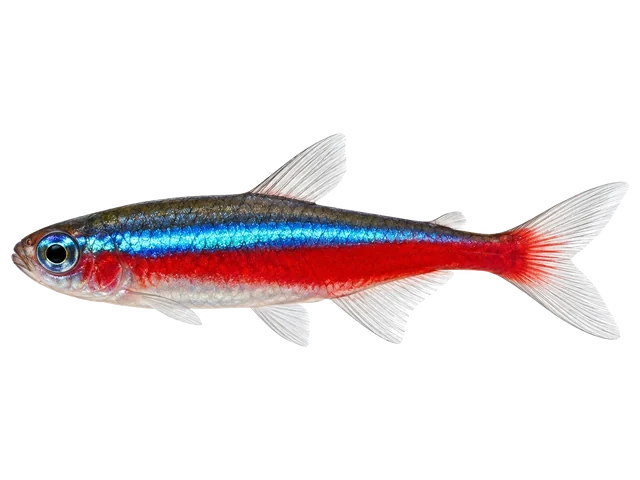
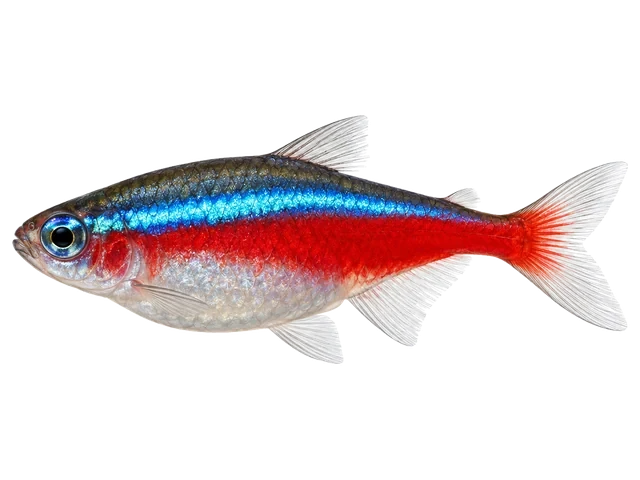
Mature females are noticeably rounder-bodied and a little larger than males.
Health
Common problems. Tap one to see the signs. This is a guide, not a diagnosis.
Breeding
Egg-scatterer ·
Egg scatterer bred in a dark tank with soft, acidic water (pH 5.5-6.5, gH 1-5). Eggs hatch in 24-36 hours, and eggs and fry are light sensitive. It is commercially bred on a large scale.
Buy a group of wild-caught or captive-bred fish. Use a group of 10 or more and condition well.
20-40 L tank with very soft, acidic water (pH 5.0-6.0), dim light, a dark bottom and fine mops or moss.
Very soft acid water, cooler temperature drop and dim light.
Up to 100-500 eggs reported in good spawns; hatch in about 24 hours. Success is often low.
Feed infusoria, then rotifers and fresh baby brine shrimp. Fry are sensitive, so keep water soft and clean. Grow out in dim light.
- Using hard or neutral water
- Bright light that kills eggs
- Using unconditioned wild fish
Where it lives in the wild
Plants that suit it
The story of the cardinal tetra
Named after the publisher Dr. Herbert R. Axelrod. Many are still wild-caught around Barcelos on the Rio Negro in Brazil, where the fishery is a major source of local income, though it is also commercially bred on a large scale.
The cardinal tetra was described by Leonard P. Schultz in 1956 from fish sent to the USA and named after Herbert Axelrod. It quickly rivalled the neon in popularity. Many cardinals are still collected by local fishermen in the middle Rio Negro, a fishery that provides income for riverside communities.
First described by Leonard P. Schultz in 1956. Named for Named after aquarium publisher Herbert R. Axelrod.
- Its red band runs the full length of the body, unlike the neon's half-length red.
- Barcelos on the Rio Negro holds an annual ornamental fish festival celebrating the cardinal and discus.
- Wild cardinals live in water so soft and acidic that few other fish thrive there.
Sources
15 facts checked with sources
- Scientific nameFishBase: Paracheirodon axelrodi summary · Seriously Fish: Paracheirodon axelrodi
- Familycorrected
Melo et al. 2024 split the old Characidae; FishBase now places Paracheirodon in Acestrorhamphidae. Seriously Fish still says Characidae. FishBase preferred for taxonomy.
FishBase: Paracheirodon axelrodi summary · Melo et al. 2024, Phylogenomics of Characidae... four families, Zool. J. Linn. Soc. 202(1) · Seriously Fish: Paracheirodon axelrodi - Sizecorrected
Both sources give SL (standard length, no tail): FishBase max 3.0 cm SL; Seriously Fish 3.5 cm SL. Per the brief FishBase's SL is recorded. Site's 4.5 cm would be a generous total length; even from Seriously Fish's 3.5 cm SL a total length of ~4-4.5 cm is plausible but not sourced.
FishBase: Paracheirodon axelrodi summary · Seriously Fish: Paracheirodon axelrodi - Temperature
Matches Seriously Fish exactly (preferred for husbandry); FishBase gives 23-27.
Seriously Fish: Paracheirodon axelrodi · FishBase: Paracheirodon axelrodi summary - pH
Inside Seriously Fish's range (preferred). FishBase gives 4.0-6.0.
Seriously Fish: Paracheirodon axelrodi · FishBase: Paracheirodon axelrodi summary - Hardness
Inside the Seriously Fish range.
Seriously Fish: Paracheirodon axelrodi · FishBase: Paracheirodon axelrodi summary - Smallest tank
60 x 30 cm base x 30 cm height = 54 L (Seriously Fish lists ~54 L). Site's 60 L meets and slightly exceeds this minimum, so kept.
Seriously Fish: Paracheirodon axelrodi - Group sizecorrected
Legacy 8 matches the source.
Seriously Fish: Paracheirodon axelrodi - Lifespan
Seriously Fish: in the wild it is a 'virtually annual fish' (individuals over a year old rarely found) but it 'can live considerably longer in aquaria'. No figure for captive lifespan found; FishBase gives none.
Seriously Fish: Paracheirodon axelrodi - TemperamentSeriously Fish: Paracheirodon axelrodi
- Swimming levelFishBase: Paracheirodon axelrodi summary
- Where it lives
Value adds the countries.
FishBase: Paracheirodon axelrodi summary · Seriously Fish: Paracheirodon axelrodi - Male or femaleSeriously Fish: Paracheirodon axelrodi
- Breedingcorrected
Site has no breeding text; compared with legacy. Soft acidic water and darkness verified. Hatch 24-36 h (legacy 'about 24 h' is at the low end). Legacy egg count 100-500 not found in a source. 'Rarely bred at home' is not stated by the source; that it is commercially bred on a large scale is,.
Seriously Fish: Paracheirodon axelrodi - Story
Site has no story; legacy 'about' text checked. Seriously Fish: in Barcelos municipality the species accounts for as much as 60% of annual income. The legacy claim that the red stripe runs the full body length was not checked against a source and is left out of the value. Legacy breeding.biz 'almost all sold are wild caught' conflicts with Seriously Fish ('commercially-bred on a large scale').
Seriously Fish: Paracheirodon axelrodi