

Variations
1 kinds · tap one for a closer look
Cherry barb
Peaceful, slightly shy; likes plants.
- Tinfoil barb eats animals up to about 5 cm. Cherry barb only grows to 5 cm.
- White cloud mountain minnow needs cool water and makes a lot of waste, while Cherry barb is tropical.
- They need different temperatures (23–27 °C vs 14–22 °C). No setting suits both.
- Giant gourami eats animals up to about 10 cm. Cherry barb only grows to 5 cm.
- Only a narrow temperature range suits both: 23–24 °C.
- Only a narrow temperature range suits both: 23–24 °C.
371 species in our list are a good match.
Care and water
Behavior
Peaceful, slightly shy; likes plants.
Food
Flakes, small pellets, frozen foods.
Tap a food to see what it is.
Male or female
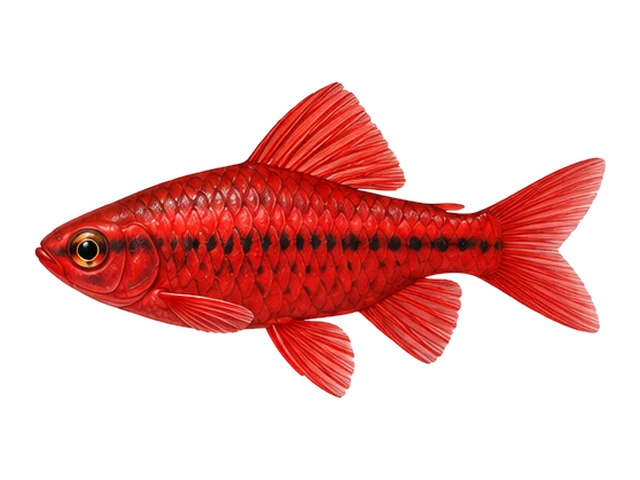
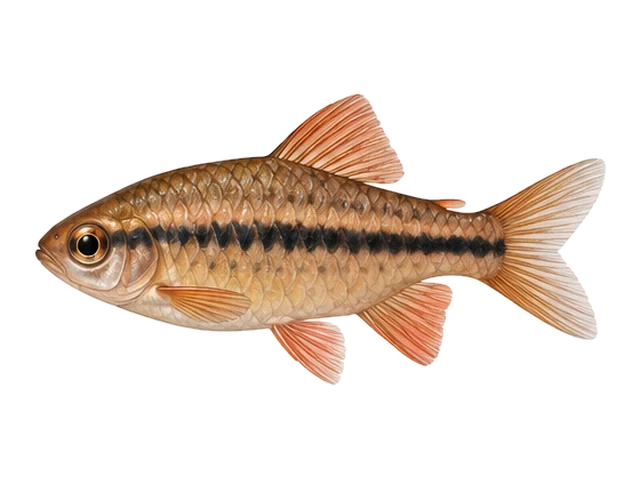
Adult males are smaller, slimmer and much more colourful (cherry red, especially when spawning) than females.
Health
Common problems. Tap one to see the signs. This is a guide, not a diagnosis.
Breeding
Egg-scatterer · Easy
Egg-scattering free spawner with no parental care; eggs are scattered among plants.
Buy a small group and let them pair up. Males are red; females are paler.
30 L tank with fine plants or a spawning mop. Dim light.
Warm water, plenty of live food and cover.
About 200-300 eggs; eggs hatch in 24-48 hours and fry are free-swimming about a day later.
Feed infusoria or liquid food for days 1-3, then baby brine shrimp and microworms. Grow out with frequent water changes. Sort by size to cut losses.
- Leaving parents with eggs
- Too bright
- Not enough plants
Where it lives in the wild
The story of the cherry barb
A Sri Lankan endemic from heavily shaded forest streams, described by P.E.P. Deraniyagala in 1929. A generally very peaceful barb. IUCN lists it as Vulnerable, threatened by over-collection and habitat loss.
Sri Lankan zoologist P. E. P. Deraniyagala described the cherry barb in 1929. Its peaceful nature and the deep red of breeding males made it a classic community fish. Nearly all fish sold today are captive-bred.
First described by P. E. P. Deraniyagala in 1929.
- Males turn deep cherry red when ready to spawn.
- It is found naturally only in Sri Lanka.
- Unlike many barbs, it is calm and rarely nips fins.
Sources
16 facts checked with sources
- Scientific namecorrected
RENAME: Sudasinghe, Rüber & Meegaskumbura 2023 (Zoologica Scripta 52(6): 571-587) moved the cherry barb into a new one-species genus, Rohanella (named after Rohan Pethiyagoda), with Puntius titteya as its type species. AQUATAB lists it citing Eschmeyer's Catalog of Fishes 2025. FishBase and Seriously Fish have not updated and still use Puntius titteya (older names: Barbus titteya, Capoeta titteya). Shops still sell it as Puntius titteya. Suggest showing 'Rohanella titteya (formerly Puntius titteya)'.
Eschmeyer's Catalog of Fishes: ref. 40281 (Sudasinghe, Rüber & Meegaskumbura 2023) · AQUATAB: Rohanella Sudasinghe, Rüber & Meegaskumbura, 2023 · Wikipedia: Cherry barb · FishBase: Puntius titteya summary - Familycorrected
Legacy has no family; sourced value recorded. Unlike the danios, it stays in Cyprinidae.
FishBase: Puntius titteya summary · AQUATAB: Rohanella Sudasinghe, Rüber & Meegaskumbura, 2023 - Size
FishBase gives 5.0 cm TL (total length); Seriously Fish gives 50 mm SL. FishBase common length is 2.5 cm TL.
FishBase: Puntius titteya summary · Seriously Fish: Puntius titteya - Temperature
Matches FishBase exactly and lies inside Seriously Fish's 20-27 °C.
FishBase: Puntius titteya summary · Seriously Fish: Puntius titteya - pHSeriously Fish: Puntius titteya · FishBase: Puntius titteya summary
- Hardnesscorrected
Legacy has no hardness; Seriously Fish value recorded (FishBase 5-19).
Seriously Fish: Puntius titteya · FishBase: Puntius titteya summary - Smallest tank
Seriously Fish base 60 x 30 cm x 30 cm height = 54 L. Legacy 60 L is slightly above that minimum, so it is consistent.
Seriously Fish: Puntius titteya - Group sizeSeriously Fish: Puntius titteya
- Lifespan
Only Wikipedia gives a lifespan (average 4, max about 7 years), which roughly agrees with legacy, but no primary source was checked; FishBase and Seriously Fish give none. Left unknown.
Wikipedia: Cherry barb - TemperamentSeriously Fish: Puntius titteya
- Swimming level
No source names a swimming level.
FishBase: Puntius titteya summary - Where it livescorrected
Legacy has no range field (its 'about' text says Sri Lanka). Wikipedia notes introduced populations established in Mexico and Colombia.
FishBase: Puntius titteya summary · Seriously Fish: Puntius titteya - Male or female
Male colour verified. The female's 'dark side stripe' was not stated in a fetched source (common hobby description).
Seriously Fish: Puntius titteya - Breeding
'Easy' is a judgment no source states.
Seriously Fish: Puntius titteya · FishBase: Puntius titteya summary - Eggs and young
Legacy range agrees with FishBase (~200) and Wikipedia (200-300).
FishBase: Puntius titteya summary · Seriously Fish: Puntius titteya · Wikipedia: Cherry barb - Story
Shaded Sri Lankan streams and peaceful nature verified. 'Does not nip' is not stated directly in a source. IUCN status (Vulnerable, assessed 7 August 2019) from FishBase.
FishBase: Puntius titteya summary · Seriously Fish: Puntius titteya · Wikipedia: Cherry barb