

Variations
1 kinds · tap one for a closer look
Congo tetra
Peaceful but skittish; needs open swimming space and calm tankmates.
- Black skirt tetra nips fins, and Congo tetra has long fins.
- Serpae tetra nips fins, and Congo tetra has long fins.
- Tiger barb nips fins, and Congo tetra has long fins.
- Only a narrow temperature range suits both: 23–24 °C.
- Only a narrow pH range suits both: exactly 7.5.
367 species in our list are a good match.
Care and water
Behavior
Peaceful but skittish; needs open swimming space and calm tankmates.
Food
Flakes, pellets, frozen foods, some plant matter.
Tap a food to see what it is.
Male or female
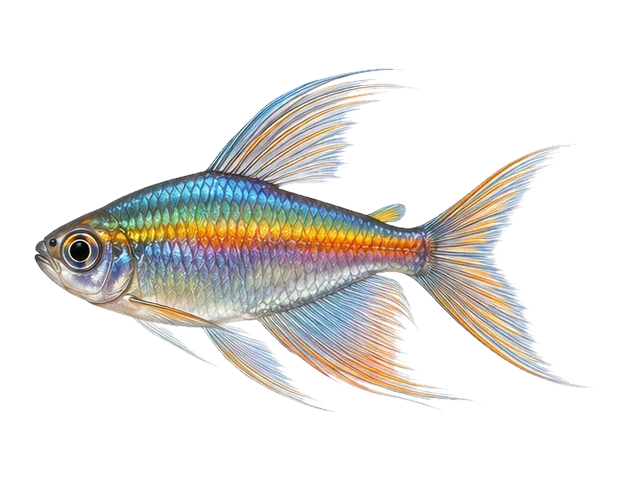
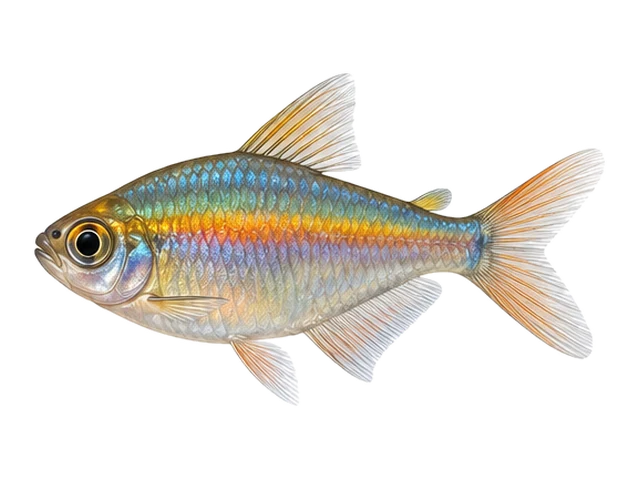
Males are larger and much more colourful, with extended tail filaments and a greatly extended dorsal fin.
Health
Common problems. Tap one to see the signs. This is a guide, not a diagnosis.
Breeding
Egg-scatterer · Moderate
Egg scatterer; eggs take about 6 days to hatch. Breeding is not easy but possible.
Buy a group of 6 or more and let them pair up. Males are larger and more colorful.
80-120 L tank with soft water, mops or fine plants, and dim light. They need space.
Soft acid water, warm temperature and plenty of live food.
A female lays up to about 300 large eggs (100-200 is more common), which sink to the bottom; they hatch in about 6 days.
Feed infusoria, then baby brine shrimp and microworms. Fry grow slowly and need a lot of food. Keep water clean and separate by size.
- Tank too small
- Hard water
- Wild-caught stress
Where it lives in the wild
The story of the congo tetra
An African tetra from the Congo River basin, described by Boulenger in 1899, with iridescent rainbow scales. Males grow much larger, more colourful fins, with long tail filaments and an extended dorsal fin.
Boulenger described the Congo tetra in 1899 from the Congo basin. It belongs to the African tetra family, not the South American one. Its shimmering rainbow scales and long, feathery fins in males made it a showpiece fish in the hobby.
First described by George A. Boulenger in 1899.
- Males grow long, frilly tail extensions; females stay smaller and plainer.
- African tetras like this one form their own family, the Alestidae.
- It scatters eggs that take several days to hatch, unusually long for a tetra.
Sources
15 facts checked with sources
- Scientific name
Described by Boulenger, 1899.
FishBase: Phenacogrammus interruptus, Congo tetra - Familycorrected
Legacy has no family. An African tetra, not affected by the 2024 split of the American Characidae.
FishBase: Phenacogrammus interruptus, Congo tetra - Sizecorrected
FishBase 8.0 cm TL (total length) for males, 6.0 cm for females; Seriously Fish 8.0 cm SL. Legacy 8.5 cm slightly high. Males are larger than females.
FishBase: Phenacogrammus interruptus, Congo tetra · Seriously Fish: Phenacogrammus interruptus - Temperature
Seriously Fish (preferred) matches legacy exactly; FishBase is narrower (23-26).
Seriously Fish: Phenacogrammus interruptus · FishBase: Phenacogrammus interruptus, Congo tetra - pHSeriously Fish: Phenacogrammus interruptus · FishBase: Phenacogrammus interruptus, Congo tetra
- Hardnesscorrected
Legacy has no hardness; sourced value recorded.
Seriously Fish: Phenacogrammus interruptus · FishBase: Phenacogrammus interruptus, Congo tetra - Smallest tankcorrected
Seriously Fish gives a 120 x 30 x 30 cm minimum for adults = 108,000 cm³ = 108 L; FishBase 100 cm long (100 x 30 x 30 = 90 L). Legacy 150 L is generous; keeping it as a recommendation is fine, but the sourced minimum is ~108 L.
Seriously Fish: Phenacogrammus interruptus · FishBase: Phenacogrammus interruptus, Congo tetra - Group size
Legacy 6 meets FishBase minimum of 5.
FishBase: Phenacogrammus interruptus, Congo tetra · Seriously Fish: Phenacogrammus interruptus - Temperament
Seriously Fish also calls it "quite an easily frightened fish", matching the legacy "skittish".
Seriously Fish: Phenacogrammus interruptus - Care level
Mixed signals: Seriously Fish difficulty rating is "Easy" but the profile stresses sensitivity to water quality and the need for space and numbers. Legacy 2 (moderate) neither confirmed nor clearly contradicted.
Seriously Fish: Phenacogrammus interruptus - Where it livescorrected
Legacy has no range field (its story says Congo River, which agrees).
FishBase: Phenacogrammus interruptus, Congo tetra · Seriously Fish: Phenacogrammus interruptus - Male or femaleSeriously Fish: Phenacogrammus interruptus
- BreedingFishBase: Phenacogrammus interruptus, Congo tetra · Seriously Fish: Phenacogrammus interruptus
- Eggs and youngcorrected
Egg count agrees with legacy; hatch time is about 6 days in both sources, not 6-8 days. Wikipedia says 6-7 days depending on temperature.
Seriously Fish: Phenacogrammus interruptus · FishBase: Phenacogrammus interruptus, Congo tetra - Story
Legacy story agrees; describer added. IUCN: Least Concern (assessed 2009, per FishBase).
FishBase: Phenacogrammus interruptus, Congo tetra · Seriously Fish: Phenacogrammus interruptus