

Variations
4 kinds · tap one for a closer look
Dwarf gourami
A colorful, calm centerpiece fish. Males can be territorial with each other.
Catalog of Fishes now treats the name Trichogaster lalius as a synonym of the banded gourami (Knight et al. 2022). We keep the familiar name until this settles.
- Dwarf gourami eats animals up to about 2.5 cm. Neon tetra only grows to 2.5 cm.
- Dwarf gourami eats animals up to about 2.5 cm. Ember tetra only grows to 2 cm.
- Dwarf gourami eats animals up to about 2.5 cm. Celestial pearl danio only grows to 2.1 cm.
- Only a narrow pH range suits both: exactly 7.5.
- Only a narrow temperature range suits both: exactly 22 °C.
386 species in our list are a good match.
Care and water
Behavior
Peaceful; males can be territorial with each other. Likes floating plants.
Food
Flakes, pellets, frozen foods.
Tap a food to see what it is.
Male or female
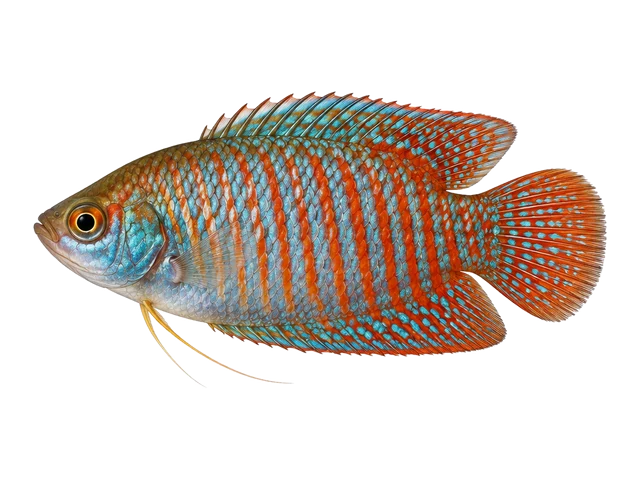
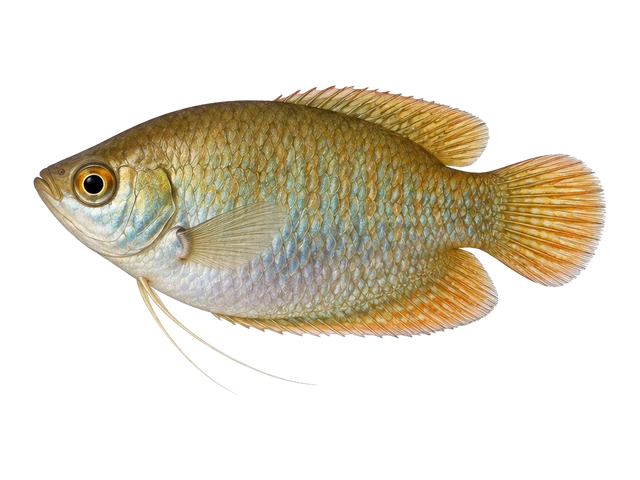
Males are a little larger and much more colourful, with red and blue stripes and longer dorsal and anal fins. Females are silvery and plainer.
Health
Dwarf gourami iridovirus (DGIV, a megalocytivirus) is a real, serious disease of dwarf gouramis linked to the ornamental fish trade; there is no known treatment. In one Sydney survey, 22% of diseased gouramis in shops carried it.
Common problems. Tap one to see the signs. This is a guide, not a diagnosis.
Breeding
Bubble-nester · Moderate
The male builds a bubble nest at the surface, often with bits of plant, and guards it. A spawn can be up to about 600-700 eggs, which usually hatch within about 36 hours.
Buy a young group and pick a calm male and a plump female. Condition with live foods.
A 10-20 gallon (40-75 L) tank, 27-28 C, low water level, lots of floating plants and a lid. Keep humid air above the water.
Warm water, floating plants and good food. The male builds a bubble nest.
300-600 eggs; they hatch in 24-48 hours.
Feed infusoria, then baby brine shrimp. Remove the female after spawning and the male when fry swim free. Keep the air above the water warm so the labyrinth organ develops.
- Cold air above the water, which harms fry
- Leaving the female with an aggressive male
- Using stock that carries Dwarf Gourami Iridovirus
Where it lives in the wild
Plants that suit it
The story of the dwarf gourami
Many farmed dwarf gouramis carry Dwarf Gourami Iridovirus, which has no cure. Buy from a trusted supplier and quarantine.
Francis Hamilton described the dwarf gourami in 1822 from the Ganges region. Its brightly striped males made it a classic community fish for decades. Many colour forms, such as powder blue and flame red, have since been bred in captivity.
First described by Francis Hamilton in 1822.
- It breathes air with a labyrinth organ.
- Males build bubble nests with plant pieces.
- Its long pelvic fins work like feelers.
Sources
15 facts checked with sources
- Scientific name
Older name Colisa lalia (FishBase URL alias; used in Go et al. 2006) is a synonym. REVIEW FLAG (added in batch 11): the banded gourami check found that Catalog of Fishes now lists the original name Trichopodus lalius as a synonym of Trichogaster fasciata, following Knight et al. 2022 (quote in species-bandedg.json). What name the dwarf gourami should carry was not checked; confirm on the Catalog of Fishes before changing anything.
FishBase: Trichogaster lalius, Dwarf gourami · Seriously Fish: Trichogaster lalius - Family
Subfamily Trichogastrinae.
FishBase: Trichogaster lalius, Dwarf gourami - Sizecorrected
FishBase max 9.5 cm TL; Seriously Fish 8.8 cm SL. Site's 8 cm is below both. FishBase value used for size; legacy 9 cm was closer.
FishBase: Trichogaster lalius, Dwarf gourami · Seriously Fish: Trichogaster lalius - Temperaturecorrected
Seriously Fish (preferred for husbandry) gives 22-27 °C; FishBase gives 25-28 °C. Only the top end differs by 1 °C.
Seriously Fish: Trichogaster lalius · FishBase: Trichogaster lalius, Dwarf gourami - pH
Exact match to Seriously Fish.
Seriously Fish: Trichogaster lalius · FishBase: Trichogaster lalius, Dwarf gourami - Hardness
Site range lies inside Seriously Fish 2-18 dGH. The sourced full range is wider (2-18).
Seriously Fish: Trichogaster lalius · FishBase: Trichogaster lalius, Dwarf gourami - Smallest tank
60 x 30 x 30 cm = 54 L (SF says 56 L). Site 60 L agrees within rounding; SF calls this a bare minimum for a pair.
Seriously Fish: Trichogaster lalius · FishBase: Trichogaster lalius, Dwarf gourami - Group sizecorrected
Seriously Fish rates it 'Social: best in a pair' (one male, one female). It doesn't say a lone fish can't be kept, so the site could keep 1 as a minimum and say a pair is best. Never two males in a normal tank (matches the oneMalePerTank trait).
Seriously Fish: Trichogaster lalius - Temperament
Seriously Fish rates its temperament 'territorial' and says it is shy; it says nothing to support 'peaceful' as such. Whether that maps to the site's 'peaceful' or 'semi-aggressive' is a judgment call, so left unknown. The site summary already warns that males are territorial.
Seriously Fish: Trichogaster lalius - Swimming level
No source names a swimming level. FishBase calls it benthopelagic; Seriously Fish only says it builds its nest at the surface and likes floating plants.
FishBase: Trichogaster lalius, Dwarf gourami · Seriously Fish: Trichogaster lalius - Care levelcorrected
Seriously Fish's Difficulty rating is 'Easy' (sub-measures: medium tank, flexible water and temperature, territorial, best in a pair). The site may still want 'moderate' because of the iridovirus risk in shop stock, but that is not what the source rates.
Seriously Fish: Trichogaster lalius - Where it lives
Seriously Fish says records from Nepal and Myanmar are probably misidentifications; feral populations exist elsewhere (e.g. Singapore, USA, Colombia).
Seriously Fish: Trichogaster lalius · FishBase: Trichogaster lalius, Dwarf gourami - Male or female
Seriously Fish also says males' dorsal and anal fins grow longer as they mature.
Seriously Fish: Trichogaster lalius - Breeding
Site claim verified. Legacy '300-600 eggs; hatch in 24-48 hours' is consistent (FishBase ~600, SF up to 700; SF ~36 h).
Seriously Fish: Trichogaster lalius · FishBase: Trichogaster lalius, Dwarf gourami - Health
Only the iridovirus entry was checked (ich not checked). The disease claim holds. Caution on wording: the 22% figure in the paper is for diseased gouramis in Sydney shops, while Seriously Fish describes it as fish coming out of Singapore. 'Many farmed fish carry it' is supported only loosely; better to say 'a significant share of shop fish tested positive'. 'No known treatment' is from Seriously Fish.
Go et al. 2006, Molecular and Cellular Probes 20(3-4):212-222, molecular epidemiology of iridovirus in Murray cod and dwarf gourami (abstract via PubMed 16697343) · Seriously Fish: Trichogaster lalius · Kurita & Nakajima 2012, Viruses 4(4):521-538, Megalocytiviruses (review; abstract via PubMed 22590684)