

Variations
3 kinds · tap one for a closer look
Kribensis
Territorial when breeding.
- Kribensis eats animals up to about 2 cm. Ember tetra only grows to 2 cm.
- Kribensis eats animals up to about 2 cm. Chili rasbora only grows to 2 cm.
- White cloud mountain minnow needs cool water and makes a lot of waste, while Kribensis is tropical.
- They need different temperatures (24–27 °C vs 14–22 °C). No setting suits both.
- Only a narrow temperature range suits both: 24–25 °C.
- Only a narrow temperature range suits both: exactly 24 °C.
346 species in our list are a good match.
Care and water
Behavior
Territorial when breeding.
- cave
Food
Pellets, frozen foods.
Tap a food to see what it is.
Male or female
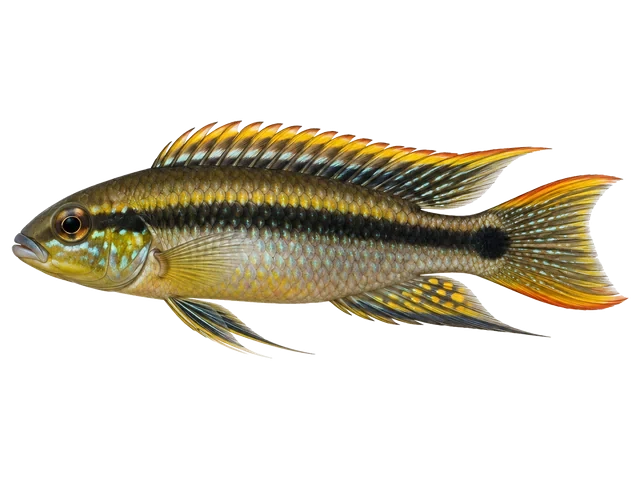
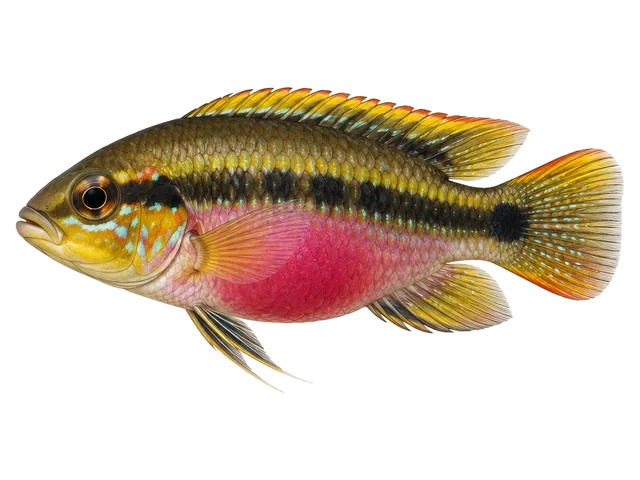
Males are larger with pointed dorsal, tail and anal fins. Females are smaller and rounder and show a bright purple-red belly in spawning condition.
Health
Common problems. Tap one to see the signs. This is a guide, not a diagnosis.
Breeding
Cave spawner · Easy
Monogamous cave spawner; eggs are laid on the roof or wall of a cave. Both parents care for the brood for about 3-4 weeks: the female mainly tends the fry and the male defends the territory. Keep pH near 6.5-7.0, as alkaline water gives mostly male broods.
Keep a pair or let a group pair off. They spawn readily.
A 20 gallon (75 L) tank with a flowerpot or coconut cave, 24-27 C and a sand bottom.
Warm water and live foods. The female turns bright purple-red.
Usually 40-100 eggs, up to about 300; they hatch in 2-3 days and fry swim freely after 7-8 days.
Feed baby brine shrimp and microworms. Leave fry with parents until 4-6 weeks, then separate.
- Not providing a cave
- Overly hard water
- Letting fry grow too crowded
Where it lives in the wild
The story of the kribensis
A West African dwarf cichlid from Nigeria and Cameroon that breeds readily in caves; both parents guard the fry, which they herd around as a family. Nearly all aquarium fish are captive-bred. The trade name 'kribensis' comes from an old mistaken scientific name, Pelmatochromis kribensis.
George A. Boulenger described the kribensis in 1901 from West Africa. Its rosy belly and easy breeding made it one of the classic West African cichlids. Pairs spawn in caves and lead their fry around the tank together.
First described by George A. Boulenger in 1901.
- Females develop a pink-red belly when breeding.
- It lays eggs in caves.
- Both parents guard the fry.
Sources
16 facts checked with sources
- Scientific name
Described by Boulenger, 1901 as Pelmatochromis pulcher. The trade name 'kribensis' comes from the misapplied name Pelmatochromis kribensis. Other Pelvicachromis species (e.g. P. taeniatus) have their own FishBase entries and are separate species; no source checked documents mislabelling.
FishBase: Pelvicachromis pulcher summary · Wikipedia: Pelvicachromis pulcher (cites FishBase; Staeck & Linke 1994) - Familycorrected
Legacy has no family field; sourced value recorded.
FishBase: Pelvicachromis pulcher summary - Size
Seriously Fish 10 cm SL (standard length); FishBase 11 cm TL (total length). Males are the larger sex; females stay smaller.
Seriously Fish: Pelvicachromis pulcher · FishBase: Pelvicachromis pulcher summary - Temperature
Matches Seriously Fish (preferred for husbandry). FishBase's 24-25 is narrower.
Seriously Fish: Pelvicachromis pulcher · FishBase: Pelvicachromis pulcher summary - pHcorrected
FishBase (5.0-8.0) covers the legacy range; Seriously Fish (preferred) tops out at 7.5 and recommends pH 6.5-7.0 for breeding, because alkaline water skews broods to males.
Seriously Fish: Pelvicachromis pulcher · FishBase: Pelvicachromis pulcher summary - Hardnesscorrected
Legacy has no hardness; Seriously Fish range recorded. Seriously Fish notes farmed fish tolerate a wider range than wild ones.
Seriously Fish: Pelvicachromis pulcher · FishBase: Pelvicachromis pulcher summary - Smallest tankcorrected
60 x 37.5 x 30 cm = 67.5 L by arithmetic; Seriously Fish states 71 L. Legacy 80 L is a little more generous; several pairs need a much larger tank.
Seriously Fish: Pelvicachromis pulcher - Group sizecorrected
Kept as a pair; Seriously Fish advises growing on 6+ juveniles and letting a pair form, since a forced pair may not accept each other.
Seriously Fish: Pelvicachromis pulcher - Temperament
Source supports 'community fish that becomes very territorial when breeding', which matches the legacy semi-aggressive rating in substance.
Seriously Fish: Pelvicachromis pulcher - Swimming level
FishBase classes the species as demersal (bottom-living) and a cave spawner; Seriously Fish says it digs pits in sand when breeding.
FishBase: Pelvicachromis pulcher summary - Care level
Seriously Fish rates it easy and hardy.
Seriously Fish: Pelvicachromis pulcher - Where it livescorrected
Legacy has no range field. IUCN: Least Concern per FishBase (assessed 22 April 2019).
FishBase: Pelvicachromis pulcher summary · Seriously Fish: Pelvicachromis pulcher - Male or female
Legacy 'cherry-red' belly; source says purple. Use 'purple-red'.
Seriously Fish: Pelvicachromis pulcher - Breeding
Legacy cave and sand advice verified. Brood care 21-28 days is shorter than the legacy 4-6 weeks with parents.
Seriously Fish: Pelvicachromis pulcher · Wikipedia: Pelvicachromis pulcher (cites Staeck & Linke 1994; Martin & Taborsky 1997) - Eggs and youngcorrected
Legacy 20-50 is below both sources. Hatch time (3 days) agrees.
Wikipedia: Pelvicachromis pulcher (cites Staeck & Linke 1994; Martin & Taborsky 1997) · Seriously Fish: Pelvicachromis pulcher - Story
Legacy claim verified; added name origin and captive-bred note.
Wikipedia: Pelvicachromis pulcher (cites Staeck & Linke 1994; Martin & Taborsky 1997) · Seriously Fish: Pelvicachromis pulcher