

Variations
1 kinds · tap one for a closer look
Lemon tetra
Peaceful schooler.
- Tinfoil barb eats animals up to about 5 cm. Lemon tetra only grows to 3.8 cm.
- White cloud mountain minnow needs cool water and makes a lot of waste, while Lemon tetra is tropical.
- Only a narrow temperature range suits both: exactly 22 °C.
- Giant gourami eats animals up to about 10 cm. Lemon tetra only grows to 3.8 cm.
- Only a narrow pH range suits both: exactly 7.5.
- Only a narrow temperature range suits both: exactly 22 °C.
367 species in our list are a good match.
Care and water
Behavior
Peaceful schooler.
Food
Colour-enhancing flakes and frozen foods.
Tap a food to see what it is.
Male or female
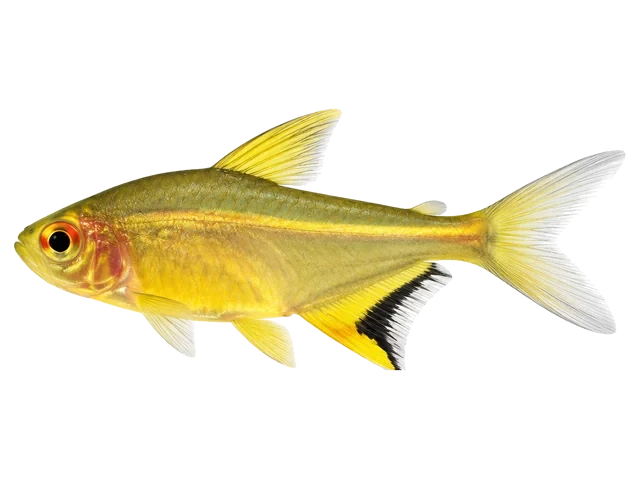
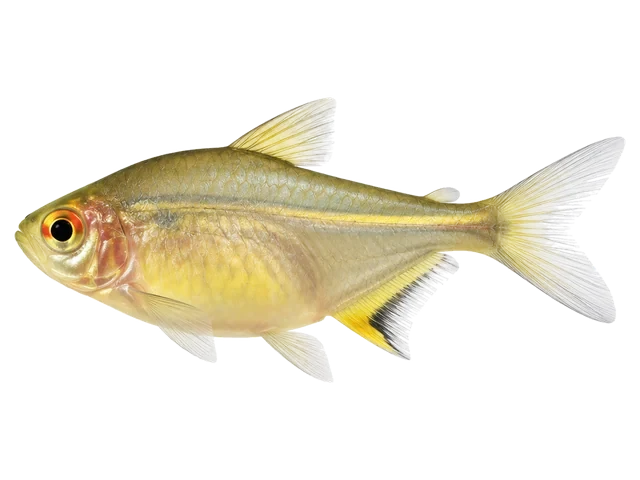
Adult males are slimmer, slightly smaller and more intensely coloured than females, especially in the dorsal and anal fins.
Health
Common problems. Tap one to see the signs. This is a guide, not a diagnosis.
Breeding
Egg-scatterer · Easy
Egg-scattering free spawner with no parental care.
Buy 6 or more and let them pair up.
20-30 L tank with fine plants or mops, slightly soft water and dim light.
Warm, soft water with plenty of conditioning foods.
Around 100-300 eggs; hatch in about 24-36 hours.
Feed infusoria or green water for days 1-3, then newly hatched brine shrimp and microworms. Keep light low early on. Grow out in a larger tank once fish are about 1 cm.
- Leaving parents with eggs
- Too bright
- Hard water
Where it lives in the wild
The story of the lemon tetra
A pale yellow tetra from the Tapajós basin of Brazil with an orange-red upper eye and black-and-yellow dorsal and anal fins (pulchripinnis means "beautiful fins"). It shows its best colour when kept in a group.
German zoologist Ernst Ahl described the lemon tetra in 1937, in the decade when many classic tetras were first exported. Its pale yellow body and red eye made it a popular community fish. Captive-bred fish are now the norm.
First described by Ernst Ahl in 1937.
- Its eye has a bright red upper rim.
- Males have a broader black edge on the anal fin than females.
- Colour is often weak in shops but deepens once settled in a planted tank.
Sources
15 facts checked with sources
- Scientific name
Described by Ahl, 1937. Seriously Fish notes an "orange red" form that may or may not be a separate species, and that the origin of the aquarium strain is questionable.
FishBase: Hyphessobrycon pulchripinnis, Lemon tetra - Familycorrected
Legacy has no family. Subfamily Hyphessobryconinae. Melo et al. 2024 (Zool. J. Linn. Soc. 202(1), "Phylogenomics of Characidae") split the old Characidae; FishBase now places this species in Acestrorhamphidae (American tetras). Seriously Fish still says Characidae. Suggest showing 'Acestrorhamphidae (American tetras; formerly Characidae)'.
FishBase: Hyphessobrycon pulchripinnis, Lemon tetra - Sizecorrected
Both SL (standard length): FishBase 3.8 cm SL (females 3.6 cm SL), Seriously Fish 4.0 cm SL. Legacy 5 cm is high even as total length (roughly 4.5-5 cm TL at most).
FishBase: Hyphessobrycon pulchripinnis, Lemon tetra · Seriously Fish: Hyphessobrycon pulchripinnis - Temperature
Legacy lies within Seriously Fish 20-28.
Seriously Fish: Hyphessobrycon pulchripinnis · FishBase: Hyphessobrycon pulchripinnis, Lemon tetra - pHcorrected
Seriously Fish (preferred) tops out at 7.5; FishBase 5.5-8.0 matches the legacy 5.5-8.
Seriously Fish: Hyphessobrycon pulchripinnis · FishBase: Hyphessobrycon pulchripinnis, Lemon tetra - Hardnesscorrected
Legacy has no hardness; sourced value recorded.
Seriously Fish: Hyphessobrycon pulchripinnis · FishBase: Hyphessobrycon pulchripinnis, Lemon tetra - Smallest tankcorrected
80 x 30 cm base x 30 cm height = 72 L. Legacy 60 L matches only FishBase (60 x 30 x 30 = 54 L).
Seriously Fish: Hyphessobrycon pulchripinnis · FishBase: Hyphessobrycon pulchripinnis, Lemon tetra - Group size
FishBase: groups of 5 or more.
Seriously Fish: Hyphessobrycon pulchripinnis - TemperamentSeriously Fish: Hyphessobrycon pulchripinnis
- Care level
Seriously Fish difficulty rating "Easy".
Seriously Fish: Hyphessobrycon pulchripinnis - Where it livescorrected
Legacy has no range field.
FishBase: Hyphessobrycon pulchripinnis, Lemon tetra · Seriously Fish: Hyphessobrycon pulchripinnis - Male or female
Agrees with legacy (brighter males, rounder females). The specific tip that the black anal-fin edge is wider in males was not confirmed word for word; Seriously Fish says the colour difference is clearest in the dorsal and anal fins.
Seriously Fish: Hyphessobrycon pulchripinnis - BreedingSeriously Fish: Hyphessobrycon pulchripinnis · FishBase: Hyphessobrycon pulchripinnis, Lemon tetra
- Eggs and young
Legacy "around 100-300 eggs; hatch in about 24-36 hours" not confirmed: no egg count or hatch time in Seriously Fish or FishBase. FishBase only says eggs are released in many batches over many spawning acts.
FishBase: Hyphessobrycon pulchripinnis, Lemon tetra - Storycorrected
Legacy says the eye is red (Seriously Fish: orange-red upper part) and that colour deepens with good food and a dark planted tank; the source only links better colour to keeping a group, so that part was changed. IUCN: Least Concern (assessed 2018, per FishBase).
Seriously Fish: Hyphessobrycon pulchripinnis