

Variations
2 kinds · tap one for a closer look
Lyretail killifish
Peaceful; jumps, so use a lid.
- Giant gourami eats animals up to about 10 cm. Lyretail killifish only grows to 6 cm.
- They need different temperatures (21–24 °C vs 26–30 °C). No setting suits both.
- Oscar eats animals up to about 12 cm. Lyretail killifish only grows to 6 cm.
- Only a narrow temperature range suits both: 23–24 °C.
- Only a narrow temperature range suits both: exactly 24 °C.
221 species in our list are a good match.
Care and water
Behavior
Peaceful; jumps, so use a lid.
Food
Frozen and live foods.
Tap a food to see what it is.
Male or female
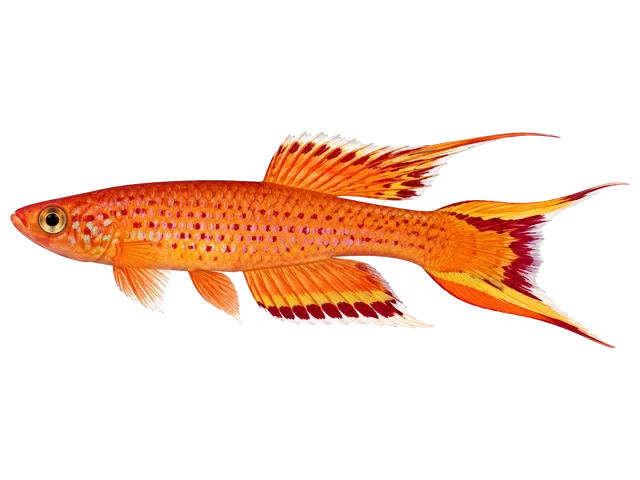
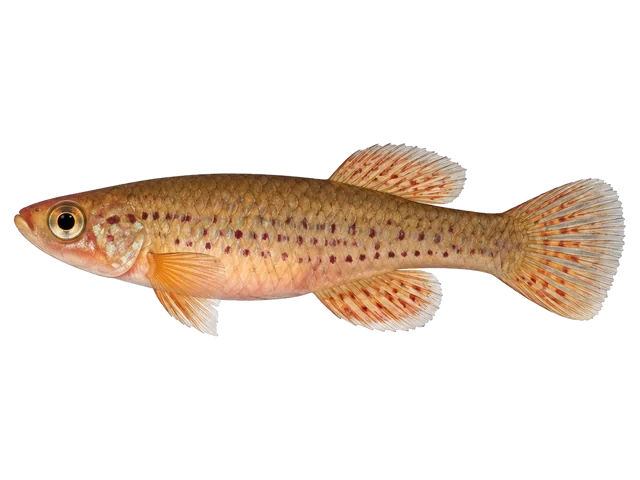
Males are larger and more brightly coloured, with extended tips to the tail, dorsal and anal fins (lyre tail); females are smaller, plainer and rounder.
Health
Common problems. Tap one to see the signs. This is a guide, not a diagnosis.
Breeding
Egg-depositor (plants) · Moderate
Spawns in fine-leaved plants such as java moss or in spawning mops; eggs are laid a few at a time every day.
Pair or trio.
Small planted tank with mops.
Warm water.
About 10-20 eggs a day for around 2 weeks; they hatch in 10-20 days depending on temperature.
Brine shrimp.
- Hard water
- Too much light
- Poor food
Where it lives in the wild
The story of the lyretail killifish
Killifish keepers often send eggs to each other by post, in water, wet peat or moss. Two colour forms are in the trade: the brown wild 'chocolate' and a man-made gold/orange form.
Arthur Rachow described the lyretail killifish in 1921. It is also called the Cape Lopez lyretail after its home in coastal Gabon. Its lyre-shaped tail and orange colours made it one of the best-known killifish.
First described by Arthur Rachow in 1921.
- Males have lyre-shaped tails.
- Its eggs stick to plants and hatch after about two weeks.
- An orange 'gold' form is common in the hobby.
Sources
16 facts checked with sources
- Scientific name
Rachow, 1921. Seriously Fish also lists the names 'golden lyretail' and 'lyretail panchax'.
FishBase: Aphyosemion australe, Lyretail panchax - Familycorrected
Legacy had no family field. Seriously Fish uses the same family.
FishBase: Aphyosemion australe, Lyretail panchax - Size
Seriously Fish 6 cm SL (standard length); FishBase 6 cm TL (total length).
Seriously Fish: Aphyosemion australe · FishBase: Aphyosemion australe, Lyretail panchax - Temperature
Exact match with FishBase. Seriously Fish gives a much wider 21-32 °C; the legacy range sits at the cool, safe end of it.
FishBase: Aphyosemion australe, Lyretail panchax · Seriously Fish: Aphyosemion australe - pH
Exact match with Seriously Fish.
Seriously Fish: Aphyosemion australe · FishBase: Aphyosemion australe, Lyretail panchax - Hardnesscorrected
Legacy had no hardness; value is new.
Seriously Fish: Aphyosemion australe · FishBase: Aphyosemion australe, Lyretail panchax - Smallest tankcorrected
Seriously Fish states 45 x 25 cm base, ~28 L for a pair or trio (45 x 25 x 25 cm = 28,125 cm³). Legacy 40 L is generous; fine as a recommendation.
Seriously Fish: Aphyosemion australe - Group size
A pair or a trio (one male, two females) is the usual unit.
Seriously Fish: Aphyosemion australe - Lifespancorrected
Seriously Fish says over 3 years is not uncommon, so legacy 2-3 years is on the low side. No maximum given (max null). Not a seasonal (annual) killifish (FishBase).
Seriously Fish: Aphyosemion australe - Temperament
Jumps: 'This species is an accomplished jumper so the cover must be very tight fitting.' (Seriously Fish) - supports the legacy lid advice.
Seriously Fish: Aphyosemion australe - Care levelcorrected
Seriously Fish difficulty: Beginner. Legacy 2 (medium) is one step harder.
Seriously Fish: Aphyosemion australe - Where it livescorrected
Legacy had no range.
Seriously Fish: Aphyosemion australe · FishBase: Aphyosemion australe, Lyretail panchax · Wikipedia: Aphyosemion australe - Male or female
'Bright orange' applies to the gold/orange strain; wild-type ('chocolate') males are brown-orange with red spots.
Seriously Fish: Aphyosemion australe - BreedingSeriously Fish: Aphyosemion australe · Wikipedia: Aphyosemion australe
- Eggs and youngcorrected
Hatch time broadly agrees (2-3 weeks vs 10-20 days); egg count is 10-20 per day rather than one batch of 'dozens'.
Seriously Fish: Aphyosemion australe - Story
Site has no story; checked against legacy 'about'. Source is a killifish society (hobby) page, not peer-reviewed. Described by Rachow, 1921 from Cape Lopez ('Cap Gentil'), Gabon. IUCN: Least Concern (per FishBase, assessed 2009).
American Killifish Association: Shipping Killies - a few basic rules (D. M. Recktenwalt) · FishBase: Aphyosemion australe, Lyretail panchax