

Variations
11 kinds · tap one for a closer look
Molly
Peaceful grazer needing hard water.
- White cloud mountain minnow needs cool water and makes a lot of waste, while Molly is tropical.
- They need different temperatures (24–28 °C vs 14–22 °C). No setting suits both.
- Giant gourami eats animals up to about 10 cm. Molly only grows to 8 cm.
- They need different temperatures (24–28 °C vs 10–22 °C). No setting suits both.
- Only a narrow temperature range suits both: 24–25 °C.
- Their pH needs don't quite meet (7.5–8.5 vs 5–7). Aim between the two and keep it steady.
- Their pH needs don't quite meet (7.5–8.5 vs 4.5–7). Aim between the two and keep it steady.
145 species in our list are a good match.
Care and water
Behavior
Peaceful grazer needing hard water.
Food
Flakes plus plenty of vegetable matter.
Tap a food to see what it is.
Male or female
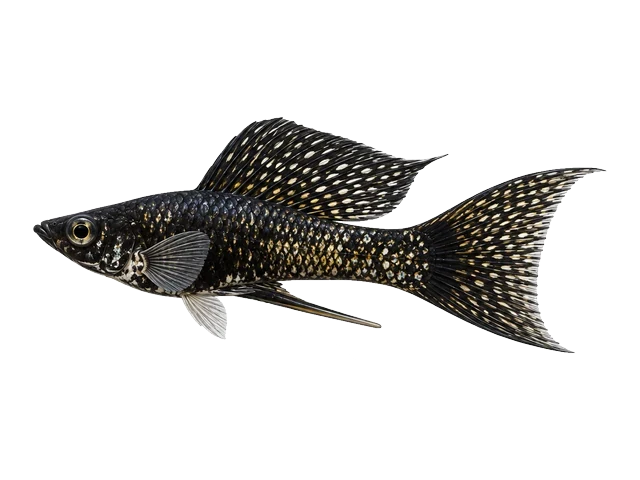
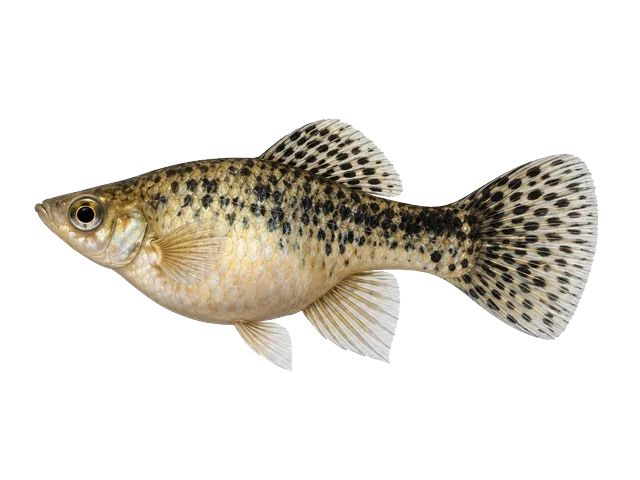
Males are smaller and more colourful and have a gonopodium; females are larger with a normal anal fin.
Health
Common problems. Tap one to see the signs. This is a guide, not a diagnosis.
Breeding
Livebearer · Easy
Livebearer; breeds readily, including hybridising with P. latipinna in aquaria.
Keep 1 male with 2-3 females. Buy a group of 6 or more young fish and let them pair up on their own.
A 20 gallon (75 L) tank with plenty of plants or spawning mops. Add a pinch of aquarium salt and keep the water hard and slightly alkaline.
Warm, clean, hard water and good food. Males chase females all year.
20-150 young per brood (broods of up to 120 are common); gestation about 4 weeks (FishBase) to around 8 weeks (Seriously Fish).
Fry are free-swimming at birth. Feed crushed flakes, baby brine shrimp and fine powder food. Move fry away from adults, or the adults will eat them.
- Keeping too many males, which stresses the females
- Soft, acidic water
- No hiding places, so the fry get eaten
Where it lives in the wild
Plants that suit it
The story of the molly
Wild P. sphenops lives in fresh and brackish water from Mexico to Colombia and Venezuela. Shop mollies, including the black molly, are domestic hybrids; the original black molly was developed by a breeder in New Orleans and first exported from the USA to Germany in 1930. Hard water matters more than salt.
Achille Valenciennes described Poecilia sphenops in 1846. Most aquarium mollies are hybrids of several species, bred into black, dalmatian and other colours. Mollies tolerate brackish and even marine water.
First described by Achille Valenciennes in 1846.
- Mollies can adapt to fully salt water.
- The black molly is a captive-bred colour form.
- Most shop mollies are hybrids of several Poecilia species.
Sources
16 facts checked with sources
- Scientific name
Poecilia sphenops Valenciennes, 1846 is a valid name for the wild short-finned molly. BUT most shop mollies are not pure P. sphenops: they are domestic hybrid strains ('fancy mollies'). Seriously Fish: some morphs come from P. sphenops x P. latipinna. Balon (2006, via Wikipedia) credits the black molly to P. sphenops x P. latipinna and the high-finned (sailfin) breeds to adding P. velifera. Schäfer (2022) says the first black mollies' ancestry is unclear and Gill's molly (P. gillii) was heavily involved. Sailfin/balloon mollies in the legacy aka list are latipinna/velifera-derived. Suggest the site label shop mollies as 'Poecilia hybrid (domestic molly; mainly P. sphenops, P. latipinna, P. velifera, P. gillii)'. FishBase also notes P. sphenops is 'Often confused with Poecilia mexicana'.
FishBase: Poecilia sphenops summary · Seriously Fish: Poecilia sphenops · Wikipedia: Fancy molly (cites Balon 2006, Aqua 11(2): 47-87, and Schäfer 2022) · Schäfer, F. 2022. Wer kennt das Volk der Mollienser? aqualog.de (German; well-established hobby reference) - Familycorrected
Legacy has no family; sourced value recorded.
FishBase: Poecilia sphenops summary - Sizecorrected
Both sources give SL (standard length): Seriously Fish 8 cm SL, FishBase 7.5 cm SL (males/unsexed). Legacy 10 cm may be a total length or a large hybrid/sailfin strain; per brief the SL figure is recorded.
Seriously Fish: Poecilia sphenops · FishBase: Poecilia sphenops summary - Temperature
Legacy range sits inside Seriously Fish's 21-28.
Seriously Fish: Poecilia sphenops · FishBase: Poecilia sphenops summary - pH
Inside Seriously Fish's 7.0-8.5.
Seriously Fish: Poecilia sphenops · FishBase: Poecilia sphenops summary - Hardnesscorrected
Legacy has no hardness. Seriously Fish (preferred) 15-30; FishBase 11-30.
Seriously Fish: Poecilia sphenops · FishBase: Poecilia sphenops summary - Smallest tankcorrected
90 x 30 cm base x 30 cm height = 81 L, as Seriously Fish states. Legacy 100 L is more generous than the sourced minimum.
Seriously Fish: Poecilia sphenops - Group size
No minimum group size given; only advice to keep several females per male.
Seriously Fish: Poecilia sphenops - Temperament
Seriously Fish says males harass females (hence several females per male) and its hard, alkaline water needs limit tankmates.
Seriously Fish: Poecilia sphenops - Swimming level
No source names a swimming level.
FishBase: Poecilia sphenops summary - Care level
Seriously Fish rates it 'Easy' but adds it is not recommended for the general community because it needs hard, alkaline water.
Seriously Fish: Poecilia sphenops - Where it livescorrected
Legacy has no range field. Applies to wild P. sphenops only; shop mollies are domestic hybrids.
FishBase: Poecilia sphenops summary · Seriously Fish: Poecilia sphenops - Male or female
The sailfin dorsal applies to latipinna/velifera-derived strains, not to P. sphenops itself.
Seriously Fish: Poecilia sphenops - BreedingFishBase: Poecilia sphenops summary · Seriously Fish: Poecilia sphenops
- Eggs and youngcorrected
Legacy upper brood size (80) is too low. Sources disagree on gestation: FishBase 28 days, Seriously Fish ~8 weeks; legacy 4-6 weeks sits between.
FishBase: Poecilia sphenops summary · Seriously Fish: Poecilia sphenops - Story
Legacy claim (fresh and brackish) verified; range extended south (FishBase/Seriously Fish). Seriously Fish: morphs 'do better in slightly brackish conditions' but salt is not necessary. Black molly history from Schäfer (2022), a well-established hobby reference (German); the breeder is named 'Crescenty'/'Crescent' and the exact ancestry is uncertain.
FishBase: Poecilia sphenops summary · Seriously Fish: Poecilia sphenops · Schäfer, F. 2022. Wer kennt das Volk der Mollienser? aqualog.de (German; well-established hobby reference)