

Variations
2 kinds · tap one for a closer look
Serpae tetra
Lively; nips fins of slow or long-finned tankmates.
- Serpae tetra nips fins, and Congo tetra has long fins.
- Tinfoil barb eats animals up to about 5 cm. Serpae tetra only grows to 4 cm.
- White cloud mountain minnow needs cool water and makes a lot of waste, while Serpae tetra is tropical.
- Only a narrow temperature range suits both: exactly 22 °C.
- Only a narrow pH range suits both: exactly 7.5.
- Only a narrow temperature range suits both: exactly 22 °C.
348 species in our list are a good match.
Care and water
Behavior
Lively; nips fins of slow or long-finned tankmates. Larger groups behave better.
Food
Flakes, pellets, frozen foods.
Tap a food to see what it is.
Male or female
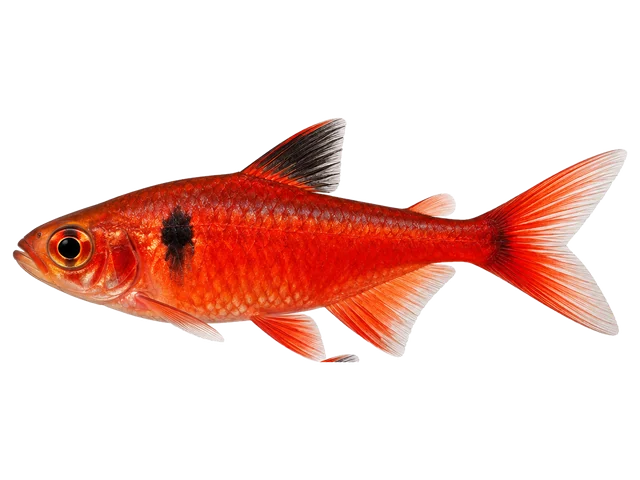
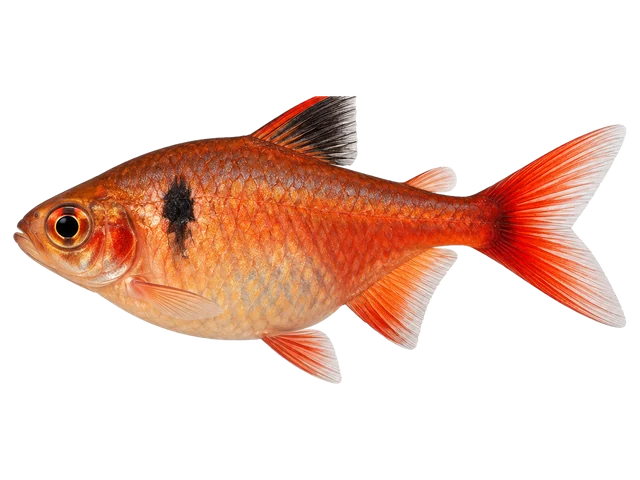
Mature females are rounder-bodied and a little larger than males; males colour up more when sparring with rival males.
Health
Common problems. Tap one to see the signs. This is a guide, not a diagnosis.
Breeding
Egg-scatterer · Easy
Egg-scattering free spawner with no parental care.
Buy a group of 6-8 and pick the fattest females and brightest males.
20-40 L tank with fine mops or java moss and slightly acidic soft water. Dim light.
Warm, soft water with a water change and heavy live food feeding.
100-300 eggs; hatch in about 24-30 hours.
Feed infusoria or green water for days 1-3, then newly hatched brine shrimp and microworms. Keep light low early on. Grow out in a larger tank once fish are about 1 cm.
- Keeping with long-fin fish (they nip)
- Leaving parents in with eggs
- Hard water
Where it lives in the wild
The story of the serpae tetra
A red tetra from the Amazon, Guaporé and Paraguay basins, described by Steindachner in 1882. It is known for nipping fins, mostly when kept in too small a group. Since 2024 it is placed in the genus Megalamphodus.
Austrian zoologist Franz Steindachner described the serpae tetra in 1882. Its bright red body made it a hobby favourite in the 20th century. It is well known for nipping fins when kept in too small a group.
First described by Franz Steindachner in 1882.
- Several similar red tetras were traded under the serpae name for years.
- Keeping it in a larger group spreads its nippy behaviour among its own kind.
- Its colour is most intense in fish kept with plants and a dark substrate.
Sources
15 facts checked with sources
- Scientific namecorrected
RENAME: Melo et al. 2024 moved it from Hyphessobrycon to the resurrected genus Megalamphodus. Shops still sell it as Hyphessobrycon eques, H. serpae or H. callistus; all are synonyms (Hyphessobrycon serpae Durbin, 1908; Tetragonopterus/Hyphessobrycon callistus Boulenger, 1900). Seriously Fish notes some of these names might be restored in future, as wild populations differ in colour. Suggest showing "Megalamphodus eques (formerly Hyphessobrycon eques)".
FishBase: Megalamphodus eques, Jewel tetra · Seriously Fish: Hyphessobrycon eques (now Megalamphodus eques) · Wikipedia: Serpae tetra (cites Melo et al. 2024, Zool. J. Linn. Soc. 202(1)) - Familycorrected
Legacy has no family. Subfamily Megalamphodinae (same subfamily as the neon tetra). Melo et al. 2024 (Zool. J. Linn. Soc. 202(1), "Phylogenomics of Characidae") split the old Characidae; FishBase now places this species in Acestrorhamphidae (American tetras). Seriously Fish still says Characidae. Suggest showing 'Acestrorhamphidae (American tetras; formerly Characidae)'.
FishBase: Megalamphodus eques, Jewel tetra - Sizecorrected
Both 4.0 cm SL (standard length). Legacy 4.5 cm is plausible as total length.
FishBase: Megalamphodus eques, Jewel tetra · Seriously Fish: Hyphessobrycon eques (now Megalamphodus eques) - Temperature
Legacy 22-27 lies within Seriously Fish 20-28 (preferred); FishBase 22-26.
Seriously Fish: Hyphessobrycon eques (now Megalamphodus eques) · FishBase: Megalamphodus eques, Jewel tetra - pH
Legacy range lies within both sources.
Seriously Fish: Hyphessobrycon eques (now Megalamphodus eques) · FishBase: Megalamphodus eques, Jewel tetra - Hardnesscorrected
Legacy has no hardness. Seriously Fish (preferred) 1-15; FishBase gives a harder 10-25.
Seriously Fish: Hyphessobrycon eques (now Megalamphodus eques) · FishBase: Megalamphodus eques, Jewel tetra - Smallest tankcorrected
80 x 30 cm base x 30 cm height = 72 L. Legacy 60 L matches only FishBase (60 x 30 x 30 = 54 L).
Seriously Fish: Hyphessobrycon eques (now Megalamphodus eques) · FishBase: Megalamphodus eques, Jewel tetra - Group sizecorrected
Seriously Fish (preferred) says 12+, because fin nipping is worst when too few are kept. Legacy 8.
Seriously Fish: Hyphessobrycon eques (now Megalamphodus eques) · FishBase: Megalamphodus eques, Jewel tetra - Temperament
Seriously Fish: nipping is most pronounced when too few are kept or space is limited. Keep a fin-nipper trait.
Seriously Fish: Hyphessobrycon eques (now Megalamphodus eques) · FishBase: Megalamphodus eques, Jewel tetra - Swimming level
FishBase describes the wild fish near the surface among plant stems, which does not match legacy "middle" exactly; no aquarium source on swimming level found.
FishBase: Megalamphodus eques, Jewel tetra - Care level
Seriously Fish difficulty rating "Easy".
Seriously Fish: Hyphessobrycon eques (now Megalamphodus eques) - Where it livescorrected
Legacy has no range field (its story says Amazon and Paraguay basins, which agrees).
FishBase: Megalamphodus eques, Jewel tetra · Seriously Fish: Hyphessobrycon eques (now Megalamphodus eques) - Male or femalecorrected
Legacy says males have a black dorsal-fin edge; not confirmed by sources (both sexes have a black dorsal fin), so dropped. "Males display to each other" agrees with Seriously Fish (males continually battle for female attention).
Seriously Fish: Hyphessobrycon eques (now Megalamphodus eques) - BreedingSeriously Fish: Hyphessobrycon eques (now Megalamphodus eques) · FishBase: Megalamphodus eques, Jewel tetra
- Story
Legacy story agrees; rename and describer added. Also sold as jewel, red minor, blood or callistus tetra. IUCN: Least Concern (assessed 2021, per FishBase).
FishBase: Megalamphodus eques, Jewel tetra · Seriously Fish: Hyphessobrycon eques (now Megalamphodus eques) · Wikipedia: Serpae tetra (cites Melo et al. 2024, Zool. J. Linn. Soc. 202(1))