

Variations
10 kinds · tap one for a closer look
Tiger barb
Busy, striped schooling fish. In small groups they nip the fins of slow, long-finned fish.
- Tiger barb nips fins, and Congo tetra has long fins.
- Tiger barb nips fins, and Guppy has long fins.
- Tiger barb nips fins, and Betta has long fins.
- Only a narrow temperature range suits both: exactly 26 °C.
- Only a narrow pH range suits both: exactly 6.
422 species in our list are a good match.
Care and water
Behavior
Fast and boisterous; a known fin-nipper. In groups of 6+ they chase each other instead of tankmates.
Food
Flakes, pellets, frozen foods, vegetables.
Tap a food to see what it is.
Male or female
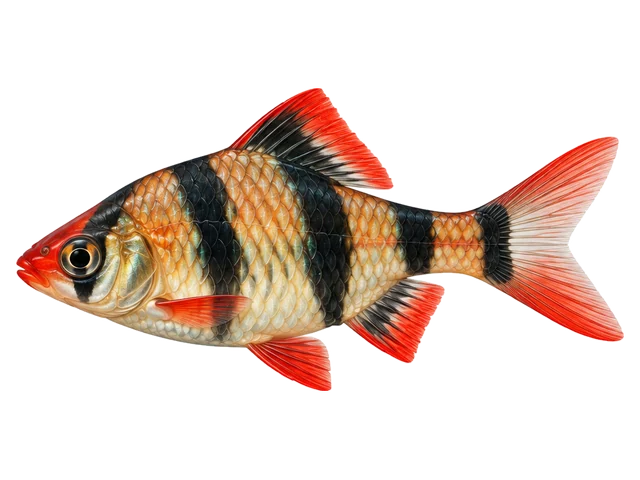
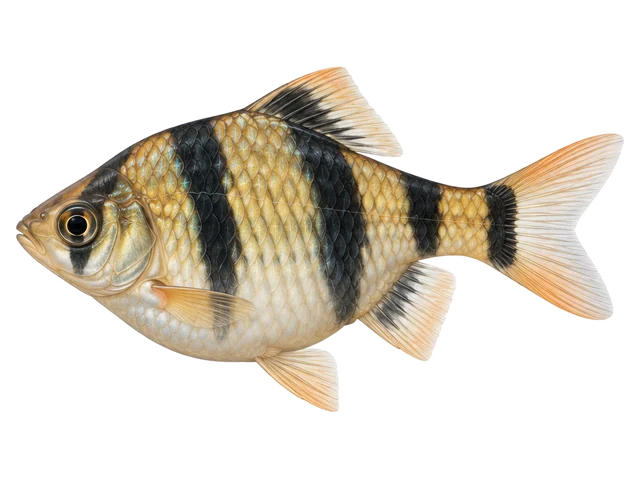
Males are smaller and slimmer with more intense colour, including a red snout and redder fins. Females are larger and rounder.
Health
Common problems. Tap one to see the signs. This is a guide, not a diagnosis.
Breeding
Egg-scatterer · Easy
An egg-scattering free spawner with no parental care; adults are removed after spawning.
Buy a group of 6-8 and pick the fattest females and brightest males.
40 L tank with fine plants or mops and a spawning grate. Dim light and slightly acid, soft water.
Warm water change, soft water and heavy live food feeding.
Several hundred eggs per spawning (up to about 500 per female); eggs hatch in 24-48 hours and fry swim freely about a day later.
Feed infusoria or liquid food for days 1-3, then baby brine shrimp and microworms. Grow out with frequent water changes. Sort by size to cut losses.
- Leaving parents with eggs
- Hard water
- Too little cover
Where it lives in the wild
The story of the tiger barb
Described by Bleeker in 1855 and moved to the new genus Puntigrus by Kottelat in 2013. It probably comes only from Sumatra, and the farmed aquarium tiger barb does not exactly match any wild species.
Dutch ichthyologist Pieter Bleeker described the tiger barb in 1855. Its bold black bands made it one of the best-known aquarium fish. Green, albino and other colour forms have since been bred in captivity.
First described by Pieter Bleeker in 1855.
- It is famous for nipping long fins of slower tankmates.
- A 'green' or 'moss' form has much broader black bands.
- It shows four black vertical bars, including one through the eye.
Sources
15 facts checked with sources
- Scientific name
Genus Puntigrus erected by Kottelat (2013); formerly Puntius/Systomus/Barbus tetrazona. Seriously Fish notes the commercial aquarium tiger barb does not precisely match any described species (possibly undescribed, hybrid, or altered by farming).
FishBase: Puntigrus tetrazona, Sumatra barb · Seriously Fish: The mystery of the aquarium tiger barb (article) - Family
Subfamily Smiliogastrinae (some recent classifications raise it to family Smiliogastridae).
FishBase: Puntigrus tetrazona, Sumatra barb - Size
FishBase 7.0 cm TL; Seriously Fish 6.0 cm SL. Consistent.
FishBase: Puntigrus tetrazona, Sumatra barb · Seriously Fish: Puntigrus tetrazona - Temperature
Legacy upper limit 27 is 1 °C high; site value matches both sources.
Seriously Fish: Puntigrus tetrazona · FishBase: Puntigrus tetrazona, Sumatra barb - pH
Seriously Fish recommends acidic to neutral water.
Seriously Fish: Puntigrus tetrazona · FishBase: Puntigrus tetrazona, Sumatra barb - Hardness
Site range lies within both.
Seriously Fish: Puntigrus tetrazona · FishBase: Puntigrus tetrazona, Sumatra barb - Smallest tankcorrected
80 x 30 cm base x 30 cm height = 72,000 cm³ = 72 L (at 35 cm height = 84 L). Site's 80 L is close and acceptable; strict arithmetic at 30 cm height gives 72 L. The 80 cm tank length matters more than the litre figure.
Seriously Fish: Puntigrus tetrazona · FishBase: Puntigrus tetrazona, Sumatra barb - Group sizecorrected
FishBase says 5+, Seriously Fish 8-10; Seriously Fish preferred for husbandry. Larger groups reduce fin-nipping of tankmates.
Seriously Fish: Puntigrus tetrazona · FishBase: Puntigrus tetrazona, Sumatra barb - Temperament
Seriously Fish says the behaviour is mostly pronounced when too few are kept or space is limited; it describes them as boisterous. Supports the finNipper trait too.
Seriously Fish: Puntigrus tetrazona · FishBase: Puntigrus tetrazona, Sumatra barb - Care level
Seriously Fish's overall difficulty rating box shows 'Easy' (6 of 8 measures).
Seriously Fish: Puntigrus tetrazona - Where it livescorrected
FishBase still lists Sumatra and Borneo, but Seriously Fish (following Kottelat 2013's revision, which split the P. tetrazona group) says Borneo records are other Puntigrus species (e.g. P. anchisporus). Took the post-revision view; FishBase normally preferred for range but its entry predates the split. Widely introduced and farmed elsewhere.
Seriously Fish: Puntigrus tetrazona · FishBase: Puntigrus tetrazona, Sumatra barb · Wikipedia: Tiger barb - Male or female
The red snout detail comes only from Wikipedia (uncited); Seriously Fish supports more intense male colour and slimmer males.
Seriously Fish: Puntigrus tetrazona · Wikipedia: Tiger barb - Breeding
Seriously Fish advises removing adults after spawning but does not explicitly say they eat the eggs.
Seriously Fish: Puntigrus tetrazona - Eggs and youngcorrected
Hatch time widened from 24-36 h to 24-48 h (Seriously Fish). Egg count: Wikipedia cites Scheurmann 1990 and Axelrod 1992 in text for up to 500; Warni et al. 2024 got ~448 eggs with hormone-induced spawning. The legacy 200-400 is plausible but not directly sourced.
Seriously Fish: Puntigrus tetrazona · Wikipedia: Tiger barb · Warni et al. 2024, Mass induction of tiger barb (Puntius tetrazona) spawning via hormone immersion technique, Egyptian Journal of Aquatic Research 50(2):267-271 (peer-reviewed) - Storycorrected
Site has no story; checked against legacy 'about'. Borneo part of the legacy claim corrected.
FishBase: Puntigrus tetrazona, Sumatra barb · Seriously Fish: The mystery of the aquarium tiger barb (article) · Seriously Fish: Puntigrus tetrazona