

Variations
2 kinds · tap one for a closer look
X-ray tetra
Peaceful, hardy shoaler.
- Tinfoil barb eats animals up to about 5 cm. X-ray tetra only grows to 4.5 cm.
- White cloud mountain minnow needs cool water and makes a lot of waste, while X-ray tetra is tropical.
- They need different temperatures (24–28 °C vs 14–22 °C). No setting suits both.
- Giant gourami eats animals up to about 10 cm. X-ray tetra only grows to 4.5 cm.
- Only a narrow temperature range suits both: 24–25 °C.
- Only a narrow temperature range suits both: exactly 24 °C.
373 species in our list are a good match.
Care and water
Behavior
Peaceful, hardy shoaler.
Food
Flakes, micro-pellets, frozen foods.
Tap a food to see what it is.
Male or female
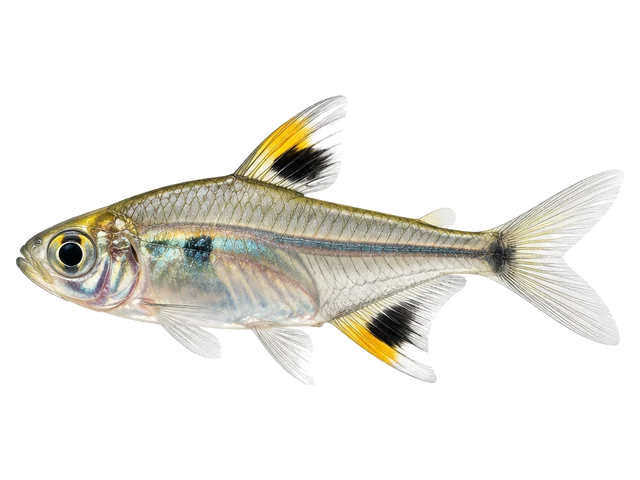
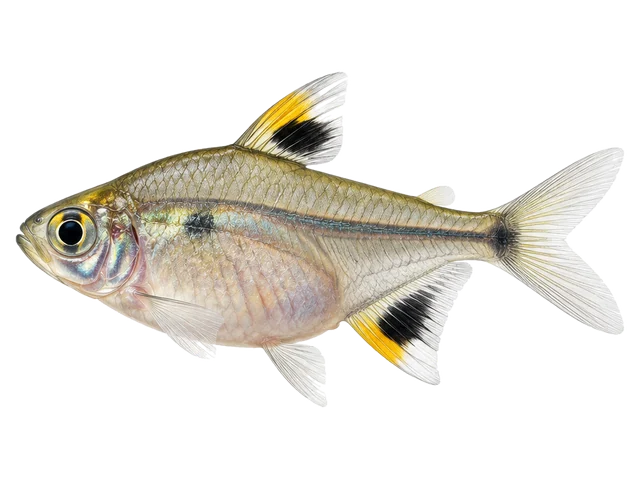
Mature females are usually bigger and noticeably stockier than males.
Health
Common problems. Tap one to see the signs. This is a guide, not a diagnosis.
Breeding
Egg-scatterer · Easy
Spawns among submerged plants; fairly easy to spawn, but the tiny fry are tricky to raise.
Buy a group of 6-8; pairs form on their own.
20 L tank with fine plants or mops. Soft, slightly acidic water.
Warm water change and live food feeding.
300-400 eggs per spawning; eggs hatch in 24-36 hours and the fry swim freely 3-4 days later.
Feed infusoria or green water for days 1-3, then newly hatched brine shrimp and microworms. Keep light low early on. Grow out in a larger tank once fish are about 1 cm.
- Leaving parents with eggs
- Hard water
- Too little cover
Where it lives in the wild
The story of the x-ray tetra
Its see-through body gives it the name X-ray tetra. It lives in calm coastal fresh waters and densely planted swamps of northern South America. The genus name Pristella means "little saw", probably for its tiny jaw teeth.
Albert B. Ulrey described this little tetra in 1894. Its nearly transparent body, which shows the swim bladder, earned it the name 'X-ray tetra'. It has been kept and bred by aquarists for many decades.
First described by Albert B. Ulrey in 1894.
- You can see its silvery swim bladder through its see-through body.
- Some wild populations live in coastal waters with a little salt.
- Its yellow, black and white dorsal fin pattern is a quick identification mark.
Sources
15 facts checked with sources
- Scientific name
Originally Aphyocarax maxillaris Ulrey, 1894; Pristella riddlei (Meek, 1907) is a junior synonym still seen in older books.
FishBase: Pristella maxillaris, X-ray tetra - Familycorrected
Legacy has no family. Subfamily Pristellinae. Melo et al. 2024 (Zool. J. Linn. Soc. 202(1), "Phylogenomics of Characidae") split the old Characidae; FishBase now places this species in Acestrorhamphidae (American tetras). Seriously Fish still says Characidae. Suggest showing 'Acestrorhamphidae (American tetras; formerly Characidae)'.
FishBase: Pristella maxillaris, X-ray tetra - Size
FishBase 4.5 cm TL (total length); Seriously Fish 4.5 cm SL.
FishBase: Pristella maxillaris, X-ray tetra · Seriously Fish: Pristella maxillaris - Temperature
Legacy matches FishBase and lies within Seriously Fish 22-28.
Seriously Fish: Pristella maxillaris · FishBase: Pristella maxillaris, X-ray tetra - pHcorrected
Seriously Fish (preferred) tops out at 7.5; FishBase allows 8.0 like the legacy value.
Seriously Fish: Pristella maxillaris · FishBase: Pristella maxillaris, X-ray tetra - Hardnesscorrected
Legacy has no hardness; sourced value recorded.
Seriously Fish: Pristella maxillaris · FishBase: Pristella maxillaris, X-ray tetra - Smallest tankcorrected
60 x 30 cm base x 30 cm height = 54 L (Seriously Fish lists ~54 L). Legacy 60 L is slightly above the minimum, so it is a safe value.
Seriously Fish: Pristella maxillaris · FishBase: Pristella maxillaris, X-ray tetra - Group sizeSeriously Fish: Pristella maxillaris
- TemperamentSeriously Fish: Pristella maxillaris · FishBase: Pristella maxillaris, X-ray tetra
- Care levelSeriously Fish: Pristella maxillaris
- Where it livescorrected
Legacy has no range field.
Seriously Fish: Pristella maxillaris · FishBase: Pristella maxillaris, X-ray tetra - Male or femalecorrected
Legacy tip about swim-bladder shape seen against a light was not found in Seriously Fish, FishBase or Wikipedia; dropped as unconfirmed. "Males slimmer" agrees.
Seriously Fish: Pristella maxillaris - BreedingSeriously Fish: Pristella maxillaris · FishBase: Pristella maxillaris, X-ray tetra
- Eggs and youngcorrected
Legacy "200-400 eggs; hatch in about 24 hours": FishBase says 300-400 eggs, Seriously Fish says 24-36 h.
FishBase: Pristella maxillaris, X-ray tetra · Seriously Fish: Pristella maxillaris - Storycorrected
Legacy says it tolerates slightly brackish water in the wild; FishBase lists it as freshwater only and no checked source mentions brackish water, so that claim was removed. A semi-albino "golden" strain exists (Seriously Fish). IUCN: Least Concern (assessed 2020, per FishBase).
FishBase: Pristella maxillaris, X-ray tetra · Wikipedia: Pristella maxillaris (cites Catalog of Fishes; Scharpf, ETYFish 2025)