

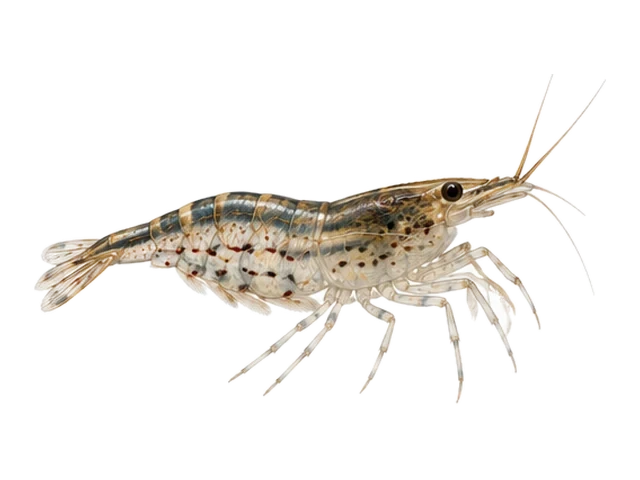
Eggs are carried and hatch in fresh water, but the larvae must drift to salt water to develop; in culture they survive best at high salinity (about 17-34 ppt, near full seawater), fed on microalgae, and metamorphose in about 22-25 days.
Buy 6-10 adults. Females are larger and have dots on the sides.
Hatching larvae must go to brackish or salt water. Needs a separate larval tank with 30 ppt salt and a lot of care.
Females release larvae when eggs are ready; they carry them 4-6 weeks. They do not trigger by water change.
Females carry 1000-2000 tiny eggs. Larvae hatch in 4-6 weeks and drift into the water.
Larvae need brackish water and green water algae, then rotifers or tiny foods. After about 30-60 days they shift to fresh water.
One breeding tank for the amano shrimp, drawn to scale from the breeding guide.
Water: 20–28 °C · pH 6.5–7.5
A plan from the breeding guide and an adult size of 3.5 cm. Tank shape is a standard 2 : 1 : 1.2 box, at least 6 adult lengths long. Check each step in the guide above.
A rack of breeding and grow-out tanks.
The breeding guide gives no tank size for the amano shrimp yet, so a business layout can't be drawn.
Females have a more elongated (dash-like) lower row of dots along the side; males have small, evenly spaced dots.
Typical for need salty water for larvae
These need brackish or sea water to raise. Not a beginner project.
Surviving young are slowly moved back to fresh water.
A general guide for this breeding type. Days change with temperature and species.
These need brackish or sea water to raise. Not a beginner project.
Set up a virtual breeding tank and see what would likely happen.
An educational estimate from the breeding rules, not a promise.