

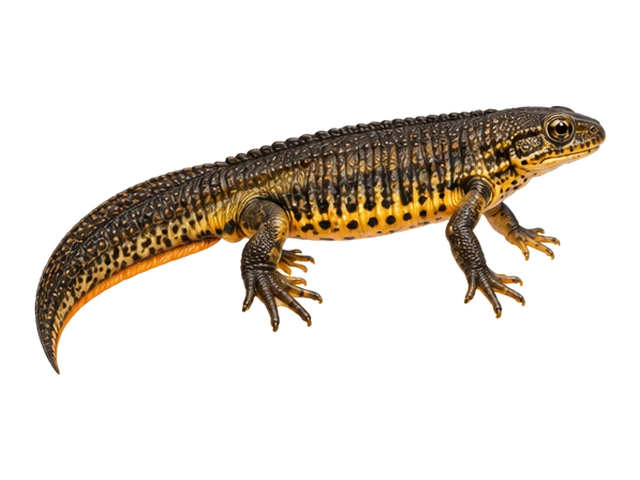
Breeds in the wet season (timing varies: October-May in parts of Spain, February-April near León). Eggs are attached in small groups to submerged plants or objects.
Pair or trio.
Large aquarium with plants and hiding spots.
Cool rest then warming.
150 (young females) to about 1,300 eggs laid over 2-3 days in groups of 9-20; larvae (11 mm) hatch after about 13 days at 18 °C.
Larvae eat daphnia, baby brine shrimp.
One breeding tank for the iberian ribbed newt, drawn to scale from the breeding guide.
Water: Unknown
A plan from the breeding guide and an adult size of 25 cm. Tank shape is a standard 2 : 1 : 1.2 box, at least 6 adult lengths long. Check each step in the guide above.
A rack of breeding and grow-out tanks.
The breeding guide gives no tank size for the iberian ribbed newt yet, so a business layout can't be drawn.
Males are slimmer and usually smaller, with longer tails; in the breeding season males develop dark nuptial pads on the front legs and a broader tail base and fin.
Typical for frogs, newts and turtles
Needs a special setup. Read the species guide first.
A general guide for this breeding type. Days change with temperature and species.
Needs a special setup. Read the species guide first.
Set up a virtual breeding tank and see what would likely happen.
An educational estimate from the breeding rules, not a promise.