

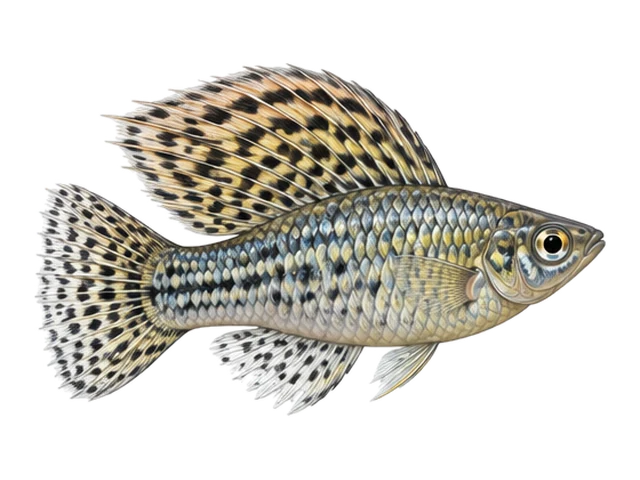
Livebearer that breeds easily in hard water; keep 2+ females per male. Gestation is longer than in most livebearers (about 4-8 weeks), and fry are large and take brine shrimp nauplii or powdered flake from birth. Domestic strains eat their fry more than wild fish.
One male to three or four females in a 100 L+ tank.
Breeding box or heavily planted tank with floating plants or spawning mops; keep the water hard, warm and slightly salty.
Warm 26-28 C water, hard pH 7.5-8.5 and plenty of vegetable food.
10-100 live young per brood (FishBase); up to about 50 in the aquarium (Seriously Fish). Gestation 28 days (FishBase) to about 2 months (Seriously Fish).
Feed crushed spirulina flake and newly hatched brine shrimp; grow in hard, warm water with 1 tsp salt per 10 L. Fry grow slowly until 3 cm.
One breeding tank for the sailfin molly, drawn to scale from the breeding guide.
Water: 21–26 °C · pH 7.2–8.5 · hard water
A plan from the breeding guide and an adult size of 12.5 cm. Tank shape is a standard 2 : 1 : 1.2 box, at least 6 adult lengths long. Check each step in the guide above.
A 120 cm rack for breeding the sailfin molly in numbers.
In total: 3 tanks, about 435 L of water. A litre of water weighs about 1 kg, so check that the floor and rack can take the weight.
Sizes are worked out from the breeding tank in the guide. Tanks fit a standard 120 cm rack when they can; bigger tanks go on their own stands.
Males have a gonopodium and a large, long, sail-like dorsal fin; females have a small dorsal fin and a normal anal fin.
Typical for livebearers
A dark 'gravid spot' grows behind the belly. Gestation is usually about 4 weeks.
Fry are born ready to swim. Thick plants or a breeding box keep them safe from adults.
Feed crushed flake, baby brine shrimp or microworms 3–5 times a day.
Males start to show color and a pointed anal fin. Separate them if you want to control lines.
Most livebearers are grown and can breed at about 3 months.
A general guide for this breeding type. Days change with temperature and species.
A dark 'gravid spot' grows behind the belly. Gestation is usually about 4 weeks.
Set up a virtual breeding tank and see what would likely happen.
An educational estimate from the breeding rules, not a promise.