

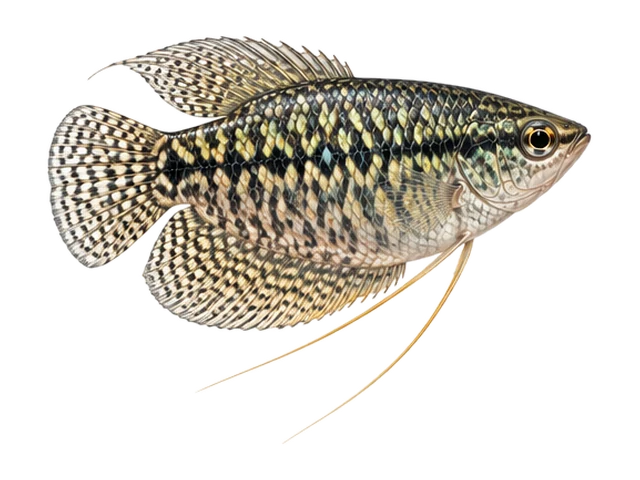
Easy-to-breed bubblenester. The male builds a large bubble nest up to about 25 cm across among floating plants, gathers the eggs into it and guards them; remove the female after spawning.
Pick the largest, healthiest fish from a group of 6-8 or buy a bonded pair.
300 L+ tank or indoor pond with floating plants and lowered water level to 25 cm; strong lighting is not needed.
Warm water change, a rise to 28 C and heavy feeding with live and frozen food.
Up to 5,000 eggs (FishBase gives 1,000-10,000); they hatch in about 20-30 hours and the fry swim freely 4-5 days later.
Newly hatched brine shrimp, microworms, then powdered food; keep room air warm for the labyrinth organ. Remove the female after spawning.
One breeding tank for the snakeskin gourami, drawn to scale from the breeding guide.
Water: 22–30 °C · pH 5.8–8.5
A plan from the breeding guide and an adult size of 30 cm. Tank shape is a standard 2 : 1 : 1.2 box, at least 6 adult lengths long. Check each step in the guide above.
A row of tanks on their own stands for breeding the snakeskin gourami in numbers.
In total: 3 tanks, about 1,500 L of water. A litre of water weighs about 1 kg, so check that the floor and rack can take the weight.
Sizes are worked out from the breeding tank in the guide. Tanks fit a standard 120 cm rack when they can; bigger tanks go on their own stands.
Males develop pointed dorsal and anal fins and orange or red pelvic fins; females are plumper.
Typical for bubble-nest builders
Feed well, then let the female see the male through glass before putting them together.
The male wraps the female and places eggs in the nest. Remove the female after spawning.
Eggs hatch in 24–48 hours. The male catches falling fry and returns them to the nest.
Remove the male. Feed infusoria and keep the air above the water warm and humid.
Move on to baby brine shrimp and microworms. Change small amounts of water daily.
Males start fighting at about 8 weeks and need their own jars.
A general guide for this breeding type. Days change with temperature and species.
Feed well, then let the female see the male through glass before putting them together.
Set up a virtual breeding tank and see what would likely happen.
An educational estimate from the breeding rules, not a promise.