

Fast and active near the surface; can nip slow fish occasionally.
447 species in our list are a good match.
Fast and active near the surface; can nip slow fish occasionally.
Flakes, pellets.
Tap a food to see what it is.
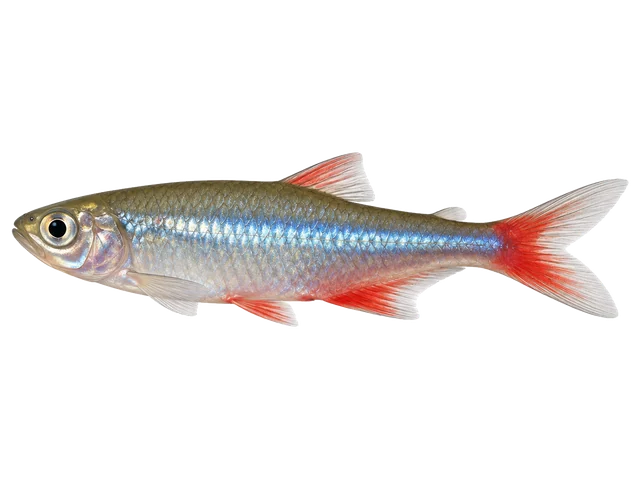
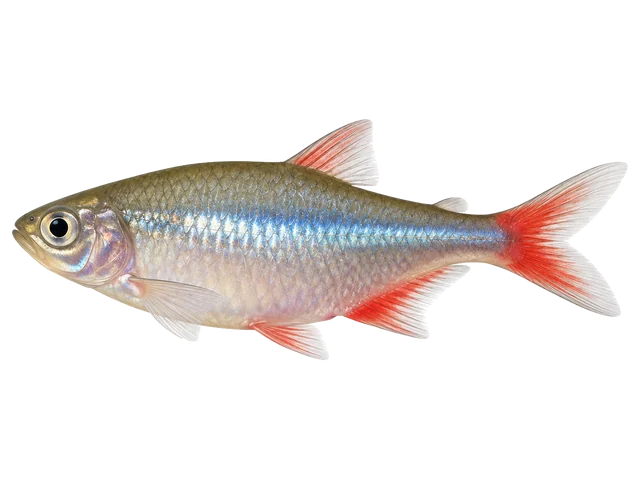
Adult males develop small hooks on some pelvic and anal fin rays; males are slimmer.
Common problems. Tap one to see the signs. This is a guide, not a diagnosis.
Egg-scatterer · Easy
Easy egg scatterer; spawn in a separate tank with fine-leaved plants and remove the adults afterwards, as they eat the eggs.
Buy 6 or more and let them pair up.
40 L tank with fine plants or mops and a spawning grate. Neutral water is fine.
Warm water change and good feeding.
Several hundred glass-clear eggs, sometimes 700-800, which sink to the bottom; they hatch in about 20-25 hours.
Feed infusoria or green water for days 1-3, then newly hatched brine shrimp and microworms. Keep light low early on. Grow out in a larger tank once fish are about 1 cm.
A silver tetra with blood-red fins, described by Eigenmann & Kennedy in 1903, from the Paraná River drainage of Argentina, Paraguay and Brazil. It tolerates cool water (down to about 18 °C) and can even be kept unheated in a warm house, though it is less colourful when cool.
Eigenmann and Kennedy described the bloodfin tetra in 1903 from Paraguay. Its red-tipped fins and tolerance of cooler water made it an old favourite in community tanks. It is very hardy and easy to breed.
First described by Carl H. Eigenmann & Clarence H. Kennedy in 1903. Named for Named after Juan Daniel Anisits, who collected fish in Paraguay.
17 facts checked with sources
Synonyms include Aphyocharax rubropinnis Pappenheim, 1921 (Seriously Fish), a name still seen in older books.
FishBase: Aphyocharax anisitsi, Bloodfin tetraLegacy has no family. Unlike most tetras, it stays in Characidae (subfamily Aphyocharacinae) after the 2024 split by Melo et al.
FishBase: Aphyocharax anisitsi, Bloodfin tetraFishBase 5.5 cm TL (total length); Seriously Fish 5.5 cm SL. Legacy 5 cm slightly low.
FishBase: Aphyocharax anisitsi, Bloodfin tetra · Seriously Fish: Aphyocharax anisitsiLegacy has no hardness; sourced value recorded.
Seriously Fish: Aphyocharax anisitsi · FishBase: Aphyocharax anisitsi, Bloodfin tetra60 x 30 cm base x 30 cm height = 54 L. Legacy 60 L is slightly above the minimum, so it is a safe value.
Seriously Fish: Aphyocharax anisitsi · FishBase: Aphyocharax anisitsi, Bloodfin tetraSeriously Fish only says fish over ten years old are not unheard of; no typical range given. Legacy "5-10 years" is consistent with that but not directly confirmed.
Seriously Fish: Aphyocharax anisitsiKeep a mild fin-nipper caution for long-finned or slow tankmates, as the legacy text says.
Seriously Fish: Aphyocharax anisitsiLegacy story says only "from Argentina"; the range also covers Paraguay and Brazil.
Seriously Fish: Aphyocharax anisitsi · FishBase: Aphyocharax anisitsi, Bloodfin tetraHooks are on pelvic as well as anal fins. Legacy tip that males catch on nets because of the hooks is plausible but not found in sources.
Seriously Fish: Aphyocharax anisitsi · Wikipedia: Bloodfin tetra (cites US Fish and Wildlife Service 2011, Ecological Risk Screening Summary)Agrees with legacy "up to several hundred eggs; hatch in about 24 hours"; FishBase adds that 700-800 is possible.
FishBase: Aphyocharax anisitsi, Bloodfin tetra · Seriously Fish: Aphyocharax anisitsiLegacy says it is "from Argentina"; the range also includes Paraguay and Brazil. Cool-water tolerance confirmed. IUCN: Least Concern (assessed 2021, per FishBase).
FishBase: Aphyocharax anisitsi, Bloodfin tetra · Seriously Fish: Aphyocharax anisitsi