

Photo by naturalist132890, CC BY · source · credits
Variations
2 kinds · tap one for a closer look
Gold barb
Peaceful, active.
- Giant gourami eats animals up to about 10 cm. Gold barb only grows to 7 cm.
- They need different temperatures (18–24 °C vs 26–30 °C). No setting suits both.
- Oscar eats animals up to about 12 cm. Gold barb only grows to 7 cm.
- Only a narrow temperature range suits both: 23–24 °C.
- Only a narrow temperature range suits both: exactly 24 °C.
313 species in our list are a good match.
Care and water
Behavior
Peaceful, active.
Food
Flakes, pellets.
Tap a food to see what it is.
Male or female
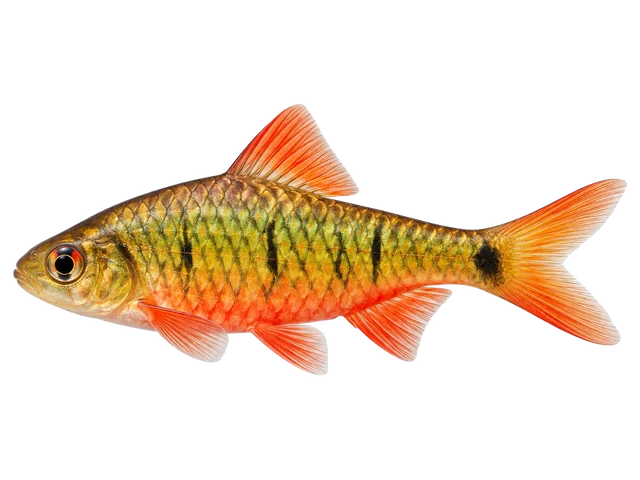
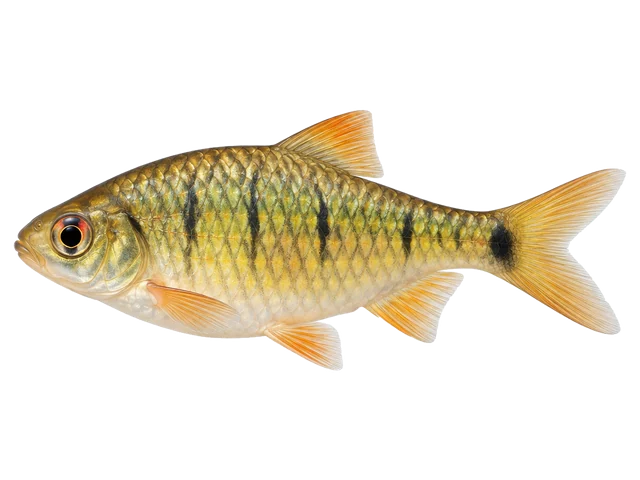
Adult females are rounder-bellied and grow slightly larger than males.
Health
Common problems. Tap one to see the signs. This is a guide, not a diagnosis.
Breeding
Egg-scatterer · Easy
Easy egg scatterer that spawns in the early morning. Use a separate, smaller tank with mature water; adults eat the eggs.
Buy 6 or more and let them pair up.
40 L tank with fine plants or mops. Spawning grate helps.
Warm water change and good live foods.
Eggs hatch in 24-48 hours and fry are free-swimming about 24 hours later.
Feed infusoria or liquid food for days 1-3, then baby brine shrimp and microworms. Grow out with frequent water changes. Sort by size to cut losses.
- Leaving parents with eggs
- Too little cover
- Overfeeding
Where it lives in the wild
The story of the gold barb
The gold barb is an ornamental golden strain of the Chinese barb, first developed in the 1960s by the American Thomas Schubert (hence the trade name 'schuberti'). A hardy subtropical fish that does well at 16-24 °C, so it suits many unheated indoor tanks.
Albert Günther described this barb in 1868. The golden aquarium form was developed in captivity and was once sold as 'Barbus schuberti', after breeder Thomas Schubert. Wild fish are greenish-gold.
First described by Albert Günther in 1868.
- The bright gold form is a captive-bred colour variety.
- It tolerates cooler water than many tropical barbs.
- The trade name 'Schubert's barb' honours the breeder of the golden form.
Sources
16 facts checked with sources
- Scientific name
Described by Günther, 1868. Formerly Puntius semifasciolatus; Kottelat (2013) moved it to Barbodes 'albeit tentatively' (Seriously Fish). 'Puntius schuberti' / 'schuberti barb' is not an official scientific name: the gold fish are an ornamental strain of this species. Puntius snyderi has been considered a synonym but is currently treated as distinct.
FishBase: Barbodes semifasciolatus summary · Seriously Fish: Barbodes semifasciolatus - Familycorrected
New value (legacy has none).
FishBase: Barbodes semifasciolatus summary - Size
FishBase 7.6 cm TL (total length) maximum; Seriously Fish 7.5 cm SL (standard length). Legacy 7 cm is within rounding of both. FishBase gives a common length of 3.5 cm SL.
FishBase: Barbodes semifasciolatus summary · Seriously Fish: Barbodes semifasciolatus - Temperature
Equal to FishBase and inside Seriously Fish's 16-24.
Seriously Fish: Barbodes semifasciolatus · FishBase: Barbodes semifasciolatus summary - pHSeriously Fish: Barbodes semifasciolatus · FishBase: Barbodes semifasciolatus summary
- Hardnesscorrected
New value (legacy has none). Seriously Fish preferred for husbandry.
Seriously Fish: Barbodes semifasciolatus · FishBase: Barbodes semifasciolatus summary - Smallest tank
90 x 30 cm base x 30 cm height = 81 L; Seriously Fish lists ~81 litres. Legacy 80 L agrees within rounding.
Seriously Fish: Barbodes semifasciolatus - Group sizecorrectedSeriously Fish: Barbodes semifasciolatus
- TemperamentSeriously Fish: Barbodes semifasciolatus
- Swimming level
No source names a swimming level.
FishBase: Barbodes semifasciolatus summary - Care level
Seriously Fish maintenance difficulty 'Easy' (7 of 8).
Seriously Fish: Barbodes semifasciolatus - Where it livescorrected
New value (legacy has none).
Seriously Fish: Barbodes semifasciolatus · FishBase: Barbodes semifasciolatus summary - Male or female
Rounder female verified. Male colour (brighter, red fins) not stated in the sources checked.
Seriously Fish: Barbodes semifasciolatus - BreedingFishBase: Barbodes semifasciolatus summary · Seriously Fish: Barbodes semifasciolatus
- Eggs and young
Hatch time verified; egg count (100-300) not found in any source.
Seriously Fish: Barbodes semifasciolatus - Story
Golden form verified (Seriously Fish credits Thomas Schubert, 1960s). 'Good for unheated tanks' is inferred from the cool temperature range, not stated directly.
Seriously Fish: Barbodes semifasciolatus · FishBase: Barbodes semifasciolatus summary