

Variations
14 kinds · tap one for a closer look
Guppy
Colorful, hardy livebearers that breed easily. Males have big painted tails.
- Black skirt tetra nips fins, and Guppy has long fins.
- Only a narrow pH range suits both: exactly 7.
- Serpae tetra nips fins, and Guppy has long fins.
- Tiger barb nips fins, and Guppy has long fins.
- Only a narrow pH range suits both: exactly 7.
- Only a narrow pH range suits both: exactly 7.
332 species in our list are a good match.
Care and water
Behavior
Peaceful top swimmers. Keep 2–3 females per male, or males only.
Food
Flakes and micro-pellets; some plant matter.
Tap a food to see what it is.
Male or female
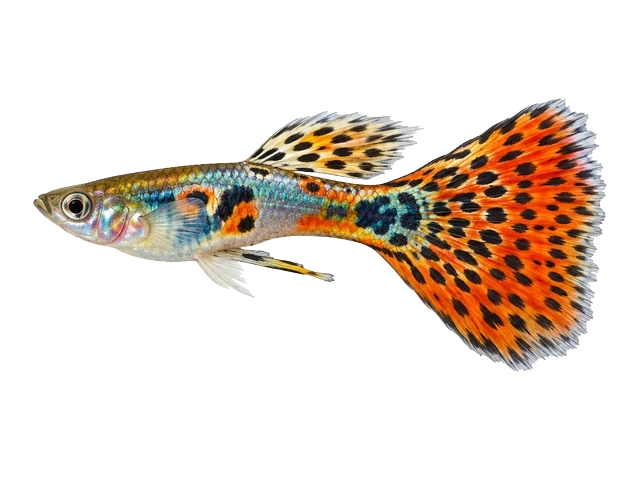
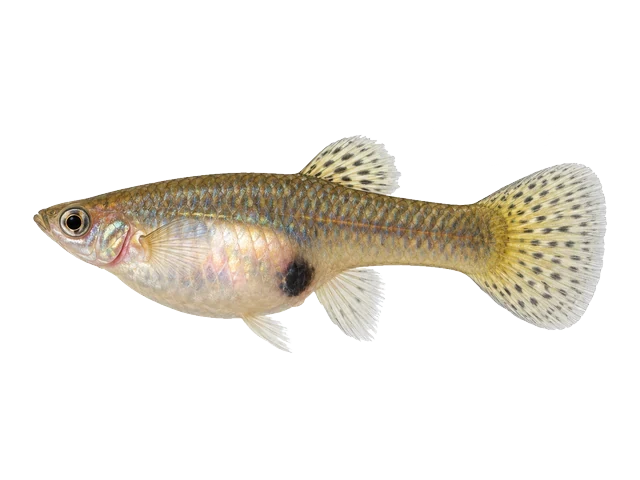
Males are smaller and colorful with a big tail and a pointed anal fin (gonopodium). Females are larger and plainer.
Health
Common problems. Tap one to see the signs. This is a guide, not a diagnosis.
Breeding
Livebearer · Easy
Livebearer. After a gestation of about 4-6 weeks females give birth to live young, usually 20-40 per brood (5-100 reported). Adults eat the fry, so plants, a breeding box or moving the fry helps.
Buy 1 male and 2-3 females, or a small group. Pick the best colors for line breeding.
40 L tank with floating plants or a breeding box and a sponge filter. Keep males and females together.
No trigger needed; females give birth about every month once mated.
10-40 young per birth; gestation is about 4 weeks.
Fry are born ready to eat. Feed crushed flake, baby brine shrimp and microworms several times a day. Separate fry from adults or use plants as cover. Sort by size and sex early.
- Overcrowding
- Inbreeding without selection
- Leaving fry with adults
Where it lives in the wild
Plants that suit it
The story of the guppy
Named after Robert John Lechmere Guppy, who sent specimens from Trinidad to the British Museum, where Albert Günther named them in his honour in 1866 (the species had already been described by Wilhelm Peters in 1859). It has been released in many countries to control mosquitoes.
Wilhelm Peters described the guppy in 1859. Its common name honours Robert J. L. Guppy, who sent fish from Trinidad to London in the 1860s. It became one of the most popular aquarium fish and a classic study animal for evolution.
First described by Wilhelm Peters in 1859. Named for Common name after Robert J. L. Guppy, who sent specimens from Trinidad.
- Trinidad guppies are a famous case study of evolution by natural selection.
- Females can store sperm and give birth several times from one mating.
- Guppies were released in many countries to control mosquito larvae.
Sources
15 facts checked with sources
- Scientific nameFishBase: Poecilia reticulata summary · Wikipedia: Guppy
- FamilyFishBase: Poecilia reticulata summary
- Sizecorrected
SL (standard length). FishBase: males 5.0 cm SL, females 6.0 cm SL; Seriously Fish 60 mm SL. The site's 5 cm matches males only; adult females reach 6 cm SL (FishBase's biology text gives a conflicting 5 cm SL for females).
FishBase: Poecilia reticulata summary · Seriously Fish: Poecilia reticulata - Temperature
Inside both ranges; sources allow cooler water than the site shows.
Seriously Fish: Poecilia reticulata · FishBase: Poecilia reticulata summary - pHSeriously Fish: Poecilia reticulata · FishBase: Poecilia reticulata summary
- Hardness
Inside the Seriously Fish range (preferred).
Seriously Fish: Poecilia reticulata · FishBase: Poecilia reticulata summary - Smallest tank
45 x 30 cm base x 30 cm height = 40.5 L; Seriously Fish lists ~41 L. Site's 40 L is the same within rounding.
Seriously Fish: Poecilia reticulata - Group size
Seriously Fish says it needs to be kept in a group with several females per male, but gives no minimum number.
Seriously Fish: Poecilia reticulata - Lifespan
Wikipedia cites Reznick et al. 2006 (wild populations); primary paper not fetched. No figure on FishBase or Seriously Fish.
Wikipedia: Guppy - TemperamentSeriously Fish: Poecilia reticulata
- Swimming level
No source names a swimming level; FishBase calls it benthopelagic.
FishBase: Poecilia reticulata summary - Where it livesSeriously Fish: Poecilia reticulata · FishBase: Poecilia reticulata summary
- Male or female
Seriously Fish also says females are generally duller in colour. Legacy 'dark gravid spot' not checked.
Seriously Fish: Poecilia reticulata - Breeding
Site text verified ('every month or so' fits 4-6 weeks gestation). Legacy brood 10-40 / 20-50 sits inside the 5-100 range; FishBase gives 20-40. Wikipedia gives gestation 20-60 days (citing Evans & Magurran 2000).
FishBase: Poecilia reticulata summary · Seriously Fish: Poecilia reticulata - Story
Site has no story; legacy 'about' text checked. Naming per Wikipedia citing Günther 1866, Catalogue of the Fishes in the British Museum vol. 6. 'Hundreds of varieties' was not found in a source and is left out.
Wikipedia: Guppy · Seriously Fish: Poecilia reticulata