

Variations
1 kinds · tap one for a closer look
Sailfin tetra
Territorial among its own kind; keep with calm tankmates.
- Sailfin tetra eats animals up to about 3 cm. Neon tetra only grows to 2.5 cm.
- Only a narrow temperature range suits both: 24–25 °C.
- Sailfin tetra eats animals up to about 3 cm. Cardinal tetra only grows to 3 cm.
- Sailfin tetra eats animals up to about 3 cm. Ember tetra only grows to 2 cm.
- Only a narrow temperature range suits both: exactly 24 °C.
- Only a narrow temperature range suits both: 24–25 °C.
- Only a narrow pH range suits both: exactly 6.5.
233 species in our list are a good match.
Care and water
Behavior
Territorial among its own kind; keep with calm tankmates.
Food
Small frozen and live foods.
Tap a food to see what it is.
Male or female
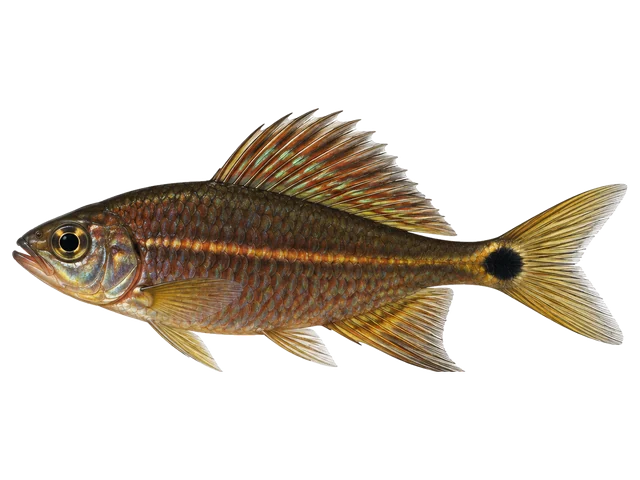
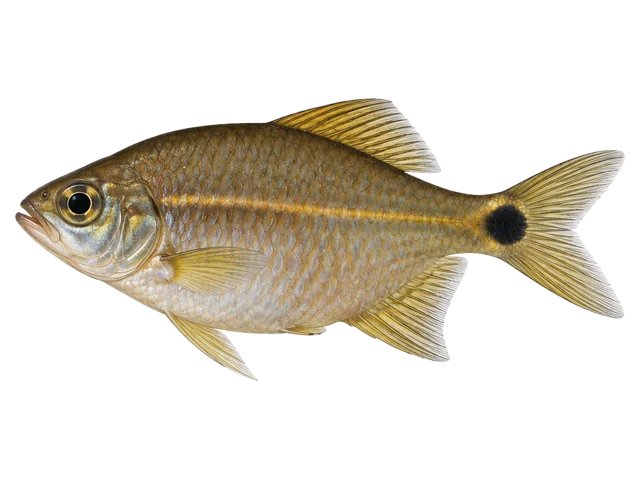
Adult males are larger and more colourful, with greatly extended dorsal and anal fins; females are relatively plain.
Health
Common problems. Tap one to see the signs. This is a guide, not a diagnosis.
Breeding
Cave spawner · Hard
A cave spawner: the male holds a small territory around a cave (often leaf litter), courts females with fin displays, and alone guards the eggs, which are stuck to the cave roof. Soft, acidic water and live foods help. Leave the eggs with the male, as his presence seems crucial.
Keep a pair or group in a tank with caves and clay pots; the male guards the eggs.
40-60 L tank with soft acidic water (pH 5-6.5), caves, bogwood and floating plants.
Soft acidic water, warmth and live food conditioning.
About 100 eggs; incubation 36-48 hours, fry free-swimming about 4-6 days later.
Fry are guarded by the male then fed on infusoria and newly hatched brine shrimp.
- Hard water
- No hiding places
- Several males in a small tank
Where it lives in the wild
The story of the sailfin tetra
A cave-spawning characin (a South American darter, not a true tetra) from the Amazon, Orinoco and Guiana rivers. Males grow a large, sail-like dorsal fin and guard the eggs.
Albert Günther described this fish in 1863. Males grow a huge, sail-like dorsal fin and guard the eggs in a hidden spot. It is a shy predator of small invertebrates and does best in a quiet, dim tank.
First described by Albert Günther in 1863. Named for 'spilurus' means spotted tail.
- Males have a huge, colourful dorsal fin.
- Males guard the eggs until they hatch.
- It belongs to the South American darter family, Crenuchidae.
Sources
16 facts checked with sources
- Scientific name
Described by Günther, 1863; the only described species in its genus, though colour and size vary across its range. Legacy alias "golden tetra" is not used by FishBase ("Sailfin tetra") or Seriously Fish ("Sailfin Characin") and is normally a name for other, gold-coloured tetras; suggest dropping it.
Eschmeyer's Catalog of Fishes: genus Crenuchus · FishBase: Crenuchus spilurus summary - Familycorrected
Legacy has no family. Not a true tetra (not Characidae); unaffected by the 2024 split of Characidae.
Eschmeyer's Catalog of Fishes: genus Crenuchus · FishBase: Crenuchus spilurus summary - Sizecorrected
Seriously Fish 7.0 cm SL (standard length) is the larger well-sourced figure; FishBase gives only 5.7 cm TL. A Seriously Fish photo caption calls an ~8 cm TL male "enormous", so legacy 8 cm is the top end, not a typical adult.
Seriously Fish: Crenuchus spilurus · FishBase: Crenuchus spilurus summary - Temperature
Legacy 24-28 equals FishBase and lies inside Seriously Fish 20-28.
Seriously Fish: Crenuchus spilurus · FishBase: Crenuchus spilurus summary - pH
Legacy 4.5-6.5 lies inside Seriously Fish 4.0-6.5 (preferred). FishBase narrower 5.5-6.5.
Seriously Fish: Crenuchus spilurus · FishBase: Crenuchus spilurus summary - Hardnesscorrected
Legacy has no hardness; very soft water.
Seriously Fish: Crenuchus spilurus · FishBase: Crenuchus spilurus summary - Smallest tankcorrected
75 x 30 cm base x 30 cm height = 67,500 cm³ = ~68 L. Legacy 100 L is generous rather than wrong.
Seriously Fish: Crenuchus spilurus - Group sizecorrected
Not a shoaling fish; Seriously Fish rates it "best in a pair" and FishBase calls it solitary and territorial. Legacy 3 is workable in a larger tank but the sourced minimum is a pair.
Seriously Fish: Crenuchus spilurus · FishBase: Crenuchus spilurus summary - Temperamentcorrected
Legacy "semi-aggressive" overstates it: peaceful and timid toward other species; males are mildly territorial toward each other.
Seriously Fish: Crenuchus spilurus - Swimming levelcorrected
Legacy "middle"; Seriously Fish describes it as predominantly benthic (FishBase's generic "pelagic" tag is not a behavioural description).
Seriously Fish: Crenuchus spilurus - Care levelcorrected
Seriously Fish rates it Moderate; it needs soft, acidic water and a mature tank. Legacy 3 (hard) is a notch high.
Seriously Fish: Crenuchus spilurus - Where it livescorrected
Legacy has no range field; type locality is the Essequibo, Guyana.
Eschmeyer's Catalog of Fishes: genus Crenuchus · FishBase: Crenuchus spilurus summary - Male or femaleSeriously Fish: Crenuchus spilurus
- Breeding
Legacy cave-spawner / male-guarding text agrees.
Seriously Fish: Crenuchus spilurus · FishBase: Crenuchus spilurus summary - Eggs and young
Legacy "30-100 eggs" is consistent with FishBase's "about a hundred".
FishBase: Crenuchus spilurus summary · Seriously Fish: Crenuchus spilurus - Story
Legacy story correct but its range ("Amazon basin") is incomplete.
Seriously Fish: Crenuchus spilurus · Eschmeyer's Catalog of Fishes: genus Crenuchus