

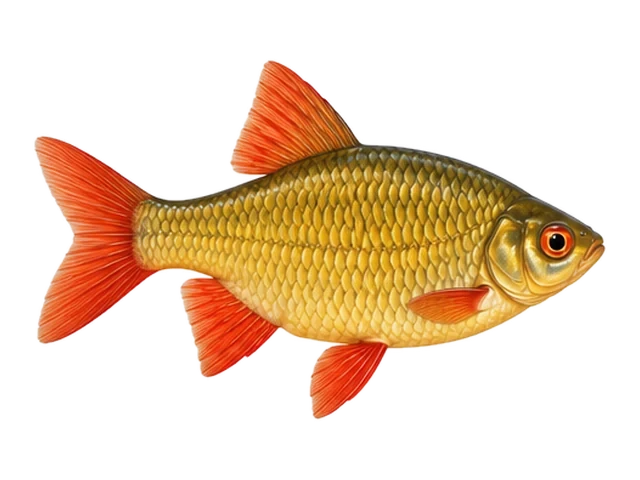
Spawns once a year in spring or summer when the water passes about 16-18°C; males drive ripe females into dense plants, where the very sticky eggs are attached.
Group.
Pond with plants.
Spring warming.
Thousands to over 200,000 very sticky, colourless to pale yellow eggs per female, attached to plants in shallow water.
Fry eat plankton.
One breeding tank for the golden rudd, drawn to scale from the breeding guide.
Water: 4–22 °C · pH 7–8
A plan from the breeding guide and an adult size of 50 cm. Tank shape is a standard 2 : 1 : 1.2 box, at least 6 adult lengths long. Check each step in the guide above.
A rack of breeding and grow-out tanks.
The breeding guide gives no tank size for the golden rudd yet, so a business layout can't be drawn.
Mature females are fuller-bodied and grow faster; mature males develop breeding tubercles.
Typical for egg scatterers
Feed live or frozen food twice a day. Keep males and females apart if you can.
Eggs are scattered over mops or fine plants, often at first light. Remove the parents straight after.
Most eggs hatch in 1–2 days. Keep the tank dim and remove white (fungused) eggs.
Fry use up the yolk and start swimming. Feed infusoria or liquid fry food several times a day.
Switch to newly hatched brine shrimp or microworms. Start small, daily water changes.
Add finely crushed flake. Sort fry by size so the big ones don't eat the small ones.
Most small fish reach about 2 cm in 2–3 months and can join the main tank.
A general guide for this breeding type. Days change with temperature and species.
Feed live or frozen food twice a day. Keep males and females apart if you can.
Set up a virtual breeding tank and see what would likely happen.
An educational estimate from the breeding rules, not a promise.