

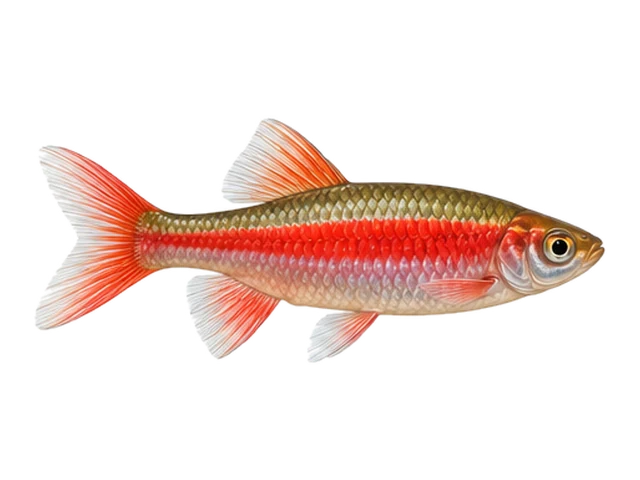
Males claim a cave or the underside of a flat object (rock, wood, tile) and the female sticks her eggs to its ceiling; the male alone guards, cleans and aerates the eggs. Spawns repeatedly from late spring through summer above about 18 °C.
Group with a spawning tile.
Pond or tank with flat tile or pipe.
Warm spring temperatures.
Each spawning gives up to about 400 eggs, laid in a single layer on the nest ceiling; a female may spawn 16-26 times a season. Eggs hatch in 4-5 days at 25 °C, up to 13 days at 15 °C.
Fry take infusoria then flake.
One breeding tank for the rosy red minnow, drawn to scale from the breeding guide.
Water: 4–26 °C · pH 7–7.5
A plan from the breeding guide and an adult size of 10 cm. Tank shape is a standard 2 : 1 : 1.2 box, at least 6 adult lengths long. Check each step in the guide above.
A rack of breeding and grow-out tanks.
The breeding guide gives no tank size for the rosy red minnow yet, so a business layout can't be drawn.
Breeding males have a dark head with pale vertical bands, a spongy pad on the nape and about 16 white tubercles on the snout; they are a little larger than females. Females are plain and develop a small ovipositor before spawning.
Typical for other egg layers
See the species guide for the details.
A general guide for this breeding type. Days change with temperature and species.
See the species guide for the details.
Set up a virtual breeding tank and see what would likely happen.
An educational estimate from the breeding rules, not a promise.