

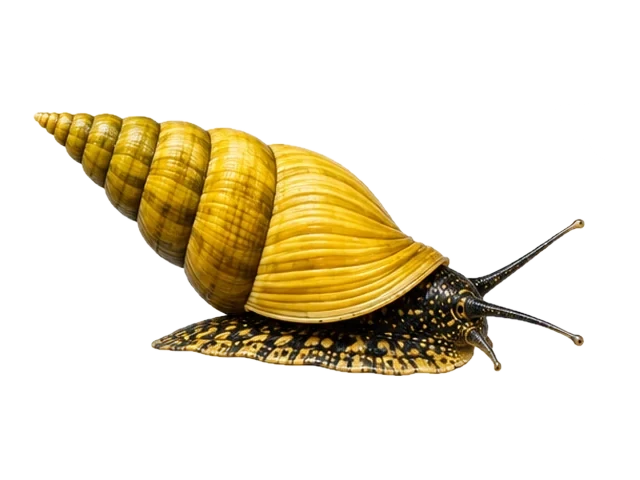
Live-bearing: the female releases one fully formed young snail at a time, in a milky-white sac it soon eats, every few weeks.
Keep 3-5 in a group and let them pair up.
40 L tank with hard alkaline water, rocks, wood and a sand base.
Stable warm water and regular feeding.
Females usually hold 1-7 embryos in the brood pouch at once; newborn shells are 0.5-9.3 mm high, and young are released singly every few weeks.
Baby snails look like adults and graze on biofilm; leave them in the tank.
One breeding tank for the yellow rabbit snail, drawn to scale from the breeding guide.
Water: 26–30 °C · pH 7.5–8.5 · hard water · sand bottom
A plan from the breeding guide. Tank shape is a standard 2 : 1 : 1.2 box. Check each step in the guide above.
A 120 cm rack for breeding the yellow rabbit snail in numbers.
In total: 4 tanks, about 240 L of water. A litre of water weighs about 1 kg, so check that the floor and rack can take the weight.
Sizes are worked out from the breeding tank in the guide. Tanks fit a standard 120 cm rack when they can; bigger tanks go on their own stands.
Sexes are separate, but males and females cannot be told apart externally.
Typical for snails
Clutches appear on glass, plants or above the waterline.
Baby snails hatch in about 2–4 weeks. Too many? Feed less.
A general guide for this breeding type. Days change with temperature and species.
Clutches appear on glass, plants or above the waterline.
Set up a virtual breeding tank and see what would likely happen.
An educational estimate from the breeding rules, not a promise.