

6 kinds · tap one for a closer look
Peaceful bottom dweller; territorial when breeding.
44 species in our list are a good match.
Peaceful bottom dweller; territorial when breeding. Sensitive to poor water.
Small pellets, frozen foods.
Tap a food to see what it is.
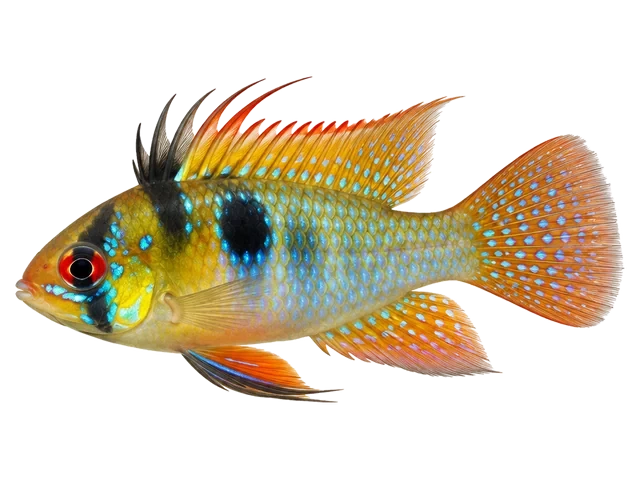
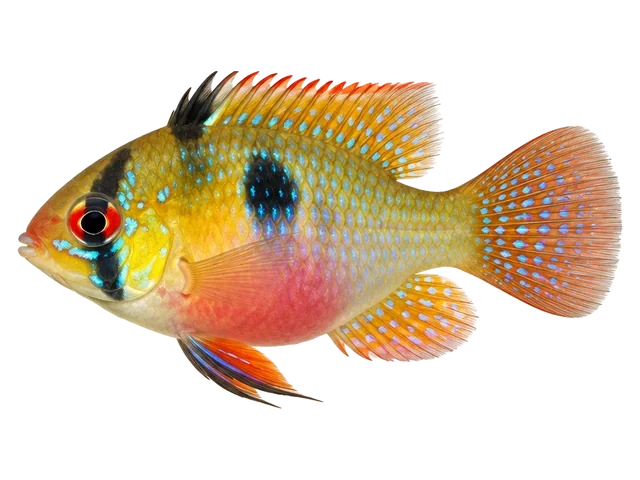
Males grow larger, with more extended fins (the first dorsal rays are elongated) and stronger colour. Most females have a pinkish belly patch that males lack, and a blue sheen over the dark spot below the dorsal fin; the belly cue may fail in some ornamental strains.
Common problems. Tap one to see the signs. This is a guide, not a diagnosis.
Egg-layer (substrate spawner) · Hard
Pairs lay eggs on a flat stone or similar surface and share care of eggs and fry. Eggs take 2-3 days to hatch; the fry then stay mostly in one place for about five days before swimming freely and need microscopic foods (microworm, infusoria) at first.
Buy a group of 6 young fish and let pairs form. Choose wild-type, healthy fish from reliable breeders.
A 20 gallon (75 L) planted tank with a flat stone, 26-29 C, soft acidic water.
Warm, soft clean water and live foods. The pair cleans a flat stone.
Typically 150-300 eggs (up to 500 reported); they hatch in 2-3 days.
Feed baby brine shrimp and microworms. Many pairs eat eggs the first time, so move eggs to a hatch tray if needed. Keep water very clean.
A jewel-like dwarf cichlid from the Orinoco llanos of Venezuela and Colombia, named after Manuel Ramirez, an early collector and importer. 'German blue' is a classic, once highly rated strain that is now bred in many countries; most shop fish are mass-farmed, possibly with hormones, and are weaker than wild stock.
George S. Myers and Robert R. Harry described the ram in 1948 from the Venezuelan llanos, originally in the genus Apistogramma. Its jewel-like colours made it one of the best-loved dwarf cichlids. Electric blue, gold and short-bodied 'balloon' forms are now bred in captivity.
First described by George S. Myers & Robert R. Harry in 1948. Named for Named after aquarium importer Manuel Vicente Ramírez.
17 facts checked with sources
Described by Myers & Harry, 1948 as Apistogramma ramirezi. Older names still seen on labels: Papiliochromis ramirezi and the misspelling Microgeophagus ramirezi; Seriously Fish says Mikrogeophagus is now generally accepted. 'German blue', 'electric blue', 'gold' and 'balloon' are trade strains of the same species, not separate species.
FishBase: Mikrogeophagus ramirezi summary · Seriously Fish: Mikrogeophagus ramirezi · Cichlid Room Companion: Mikrogeophagus ramireziLegacy has no family field; sourced value recorded.
FishBase: Mikrogeophagus ramirezi summaryBoth sources give SL (standard length): 4.0-4.2 cm. Legacy 7 cm is well above any sourced figure, even allowing for the tail.
FishBase: Mikrogeophagus ramirezi summary · Seriously Fish: Mikrogeophagus ramireziBoth sources agree on 27-30; legacy minimum of 26 is slightly low.
Seriously Fish: Mikrogeophagus ramirezi · FishBase: Mikrogeophagus ramirezi summaryInside Seriously Fish's range (preferred for husbandry); FishBase is narrower (5.0-6.0).
Seriously Fish: Mikrogeophagus ramirezi · FishBase: Mikrogeophagus ramirezi summaryLegacy has no hardness; Seriously Fish range recorded.
Seriously Fish: Mikrogeophagus ramirezi · FishBase: Mikrogeophagus ramirezi summary60 x 30 cm base x 30 cm height = 54 L (Seriously Fish: ~54 L) for one pair. FishBase also says pairs are kept in tanks of at least 60 cm. Legacy 80 L is more generous, not unsafe.
Seriously Fish: Mikrogeophagus ramireziBoth sources describe keeping it as a pair (Seriously Fish's tank size is 'for one pair'; FishBase's aquarium notes say keep in pairs). No source gives a group number; legacy 1 implies a single fish.
Seriously Fish: Mikrogeophagus ramirezi · FishBase: Mikrogeophagus ramirezi summaryNo source gives years. Seriously Fish says ornamental strains have shortened life-spans, which fits a short legacy figure but does not confirm it.
Seriously Fish: Mikrogeophagus ramireziSources recommend peaceful tankmates and describe it as a weak competitor, but no source text calling the ram itself peaceful was captured. Seriously Fish says it 'is not recommended for the general community aquarium' because it needs very clean water.
Seriously Fish: Mikrogeophagus ramireziNo source names a swimming level.
FishBase: Mikrogeophagus ramirezi summaryLegacy 3 (hardest) is stricter than the source; Seriously Fish adds that commercial strains are genetically weak, so 'moderate, with sensitive shop stock' would be faithful.
Seriously Fish: Mikrogeophagus ramireziLegacy has no range field (its 'about' text mentions the Orinoco llanos, which agrees). IUCN: Least Concern per FishBase (assessed 29 Oct 2020).
FishBase: Mikrogeophagus ramirezi summary · Seriously Fish: Mikrogeophagus ramireziLegacy verified; added that the pink-belly tip is unreliable in some colour strains.
Seriously Fish: Mikrogeophagus ramirezi · Wikipedia: Mikrogeophagus ramirezi (cites FishBase and Seriously Fish)FishBase says 'Female cares for eggs and larvae', while Linke & Staeck and Loiselle (via Wikipedia) describe both parents caring; most hobby references agree with biparental care.
Wikipedia: Mikrogeophagus ramirezi (cites Linke & Staeck; Loiselle) · Seriously Fish: Mikrogeophagus ramireziHatch time verified. Clutch size from Wikipedia citing Linke & Staeck and Baensch (aquarium atlases, not checked directly); legacy 100-250 is on the low side.
Wikipedia: Mikrogeophagus ramirezi (cites Linke & Staeck; Baensch; Richter 1989) · Seriously Fish: Mikrogeophagus ramireziOrinoco llanos verified. Seriously Fish confirms the 'German Blue' strain but does not say outright that the name comes from German breeding; that link is likely but not quoted.
Seriously Fish: Mikrogeophagus ramirezi · Wikipedia: Mikrogeophagus ramirezi (cites Leibel 1993)