

Variations
5 kinds · tap one for a closer look
Neon tetra
A tiny, peaceful schooling fish with a glowing blue stripe and a red tail half. Keep at least eight together.
- Tinfoil barb eats animals up to about 5 cm. Neon tetra only grows to 2.5 cm.
- Betta eats animals up to about 2.5 cm. Neon tetra only grows to 2.5 cm.
- Only a narrow temperature range suits both: 24–25 °C.
- Dwarf gourami eats animals up to about 2.5 cm. Neon tetra only grows to 2.5 cm.
- Only a narrow temperature range suits both: 24–25 °C.
- Only a narrow temperature range suits both: 24–25 °C.
235 species in our list are a good match.
Care and water
Behavior
Peaceful, shy schooler of the middle water. Colours and confidence improve in groups of 10 or more and in dim, planted tanks.
Food
Micro-pellets and quality flakes daily; frozen daphnia, brine shrimp or bloodworms twice a week.
Tap a food to see what it is.
Male or female
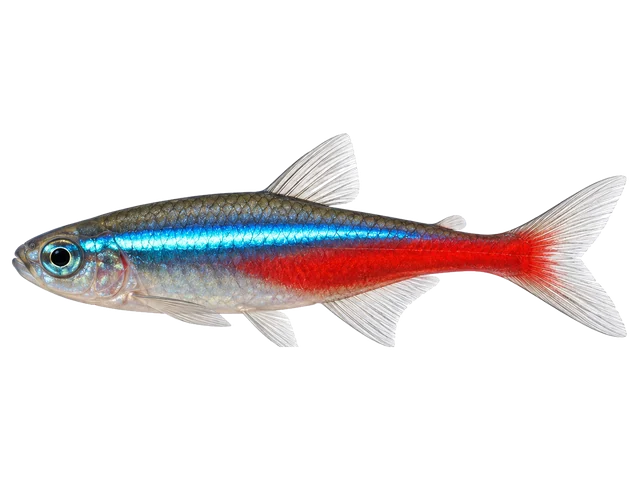
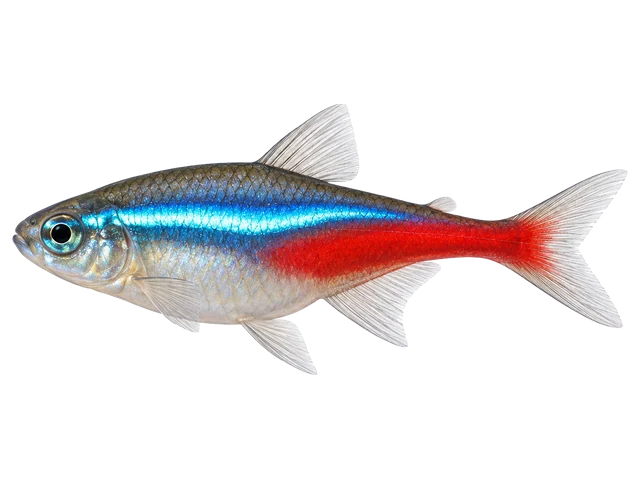
Mature females are rounder-bodied and a little larger than males.
Health
Common problems. Tap one to see the signs. This is a guide, not a diagnosis.
Breeding
Egg-scatterer · Moderate
Egg scatterer bred in a separate, very dimly lit tank with soft, acidic water (pH 5.5-6.5, gH 1-5). Adults eat the eggs, so they are removed once eggs appear. Eggs hatch in 24-36 hours and fry swim freely 3-4 days later.
Buy a group of 8-10 and let them pair up. Condition with live and frozen foods.
10-20 L bare tank with soft, acidic water (pH 5.5-6.5, very soft), spawning mops or java moss, and a dim room. Cover the sides to cut light.
Soft, slightly acidic water, a cooler water change and dim light with morning sun.
60-130 eggs per spawn; they hatch in about 24 hours and the fry swim in 4-5 days. Eggs are very light sensitive.
Feed infusoria or green water for days 1-3, then newly hatched brine shrimp and microworms. Keep light low early on. Grow out in a larger tank once fish are about 1 cm.
- Using hard tap water
- Keeping the tank bright
- Leaving adults to eat the eggs
Where it lives in the wild
Plants that suit it
The story of the neon tetra
The neon tetra was first imported from the upper Amazon in the 1930s and described by George S. Myers in 1936. It was named after the American aquarist and writer William T. Innes. Today most neons in shops are commercially farm-bred, largely in Southeast Asia.
The neon tetra was collected in the upper Amazon in the mid-1930s and shipped to Europe, where it caused a sensation among aquarists. George S. Myers described it in 1936 and honoured William T. Innes, whose aquarium books were hugely popular. Today nearly all neons in shops are farm-bred in Asia and the USA.
First described by George S. Myers in 1936. Named for Named after aquarium author William T. Innes.
- Its blue stripe can fade at night while the fish rests, then brighten again in the morning.
- The neon's iridescent stripe works by reflecting light from tiny crystal-like plates in the skin.
- Billions of neon tetras have been bred commercially, making it one of the most traded aquarium fish ever.
Sources
15 facts checked with sources
- Scientific name
Described by Myers, 1936.
FishBase: Paracheirodon innesi summary · Seriously Fish: Paracheirodon innesi - Familycorrected
Melo et al. 2024 split the old Characidae into four families; FishBase now places Paracheirodon in Acestrorhamphidae (subfamily Megalamphodinae). Seriously Fish still uses Characidae. FishBase preferred for taxonomy; the site could show 'Acestrorhamphidae (American tetras; formerly Characidae)'.
FishBase: Paracheirodon innesi summary · Melo et al. 2024, Phylogenomics of Characidae... four families, Zool. J. Linn. Soc. 202(1) · Seriously Fish: Paracheirodon innesi - Sizecorrected
Both preferred sources give SL (standard length, no tail): FishBase 2.5 cm SL, Seriously Fish 3.0 cm SL. Wikipedia gives ~4 cm overall (total) length. The site's 3.5 cm is plausible as a total length; per the brief the SL figure from FishBase is recorded. If the site field is total length, 3.5 cm is consistent with these SL figures.
FishBase: Paracheirodon innesi summary · Seriously Fish: Paracheirodon innesi · Wikipedia: Neon tetra - Temperaturecorrected
FishBase matches the site (20-26); Seriously Fish (preferred for husbandry) gives the narrower 21-25.
Seriously Fish: Paracheirodon innesi · FishBase: Paracheirodon innesi summary - pH
Site range inside Seriously Fish's 4.0-7.5 and equal to FishBase.
FishBase: Paracheirodon innesi summary · Seriously Fish: Paracheirodon innesi - Hardness
Inside the Seriously Fish range (preferred). FishBase gives a very narrow 1-2.
Seriously Fish: Paracheirodon innesi · FishBase: Paracheirodon innesi summary - Smallest tankcorrected
60 x 30 cm base x 30 cm height = 54 L; Seriously Fish lists ~54 L (14 US gal).
Seriously Fish: Paracheirodon innesi - Group sizecorrected
Legacy value (8) matches the source; site's 6 is below it.
Seriously Fish: Paracheirodon innesi - Lifespan
No lifespan on FishBase or Seriously Fish. Wikipedia says 'as long as ten years' but 'normally just two to three years in an aquarium'; its primary citation was not checked, so left unknown. The site's 5-8 years is not supported by anything found.
Wikipedia: Neon tetra - TemperamentSeriously Fish: Paracheirodon innesi
- Swimming level
No source names a swimming level; FishBase only says 'pelagic' (open water).
FishBase: Paracheirodon innesi summary - Where it lives
Seriously Fish adds that the true range 'remains unclear'.
Seriously Fish: Paracheirodon innesi · FishBase: Paracheirodon innesi summary - Male or female
Main claim (rounder females) verified. The 'bent stripe' detail was not found in a source; it is a common hobby tip but unsourced.
Seriously Fish: Paracheirodon innesi - Breeding
Site text verified. Legacy times: hatch ~24 h agrees with FishBase (Seriously Fish: 24-36 h); fry free-swimming 4-5 days vs Seriously Fish 3-4 days later. Legacy egg count 60-130 not found in a source (FishBase only says 'relatively small number').
Seriously Fish: Paracheirodon innesi · FishBase: Paracheirodon innesi summary - Story
Key facts verified (Seriously Fish: described by Myers 1936, type locality given as 'near Iquitos' from an aquarium import; honours William T. Innes, 1874-1969; most fish 'produced on a commercial basis'). 'Caused a sensation' and legacy 'Florida' were not found in a source.
Wikipedia: Neon tetra · Seriously Fish: Paracheirodon innesi